Tag: featured

  • Anti-Racist Checklist

    Anti-Racist Checklist

    Full lips, round hips, black skin is where I begin, but not where I end. – Black woman.

    It’s July 2020 and suddenly America has awakened to a realization that Black lives should matter in these United States. Operative word should. Just a few days shy of July 4th and Breonna Taylor’s family along with so many other Black families are aghast with performative measures of alliance and yet no substantive change. No arrests for the police officers who shot her while sleeping. SLEEPING. The message being communicated to Black people hasn’t changed; we say that we are with you, but our systems remain the same. Our systems don’t support your thriving and barely support surviving. Enter the work of anti-racism.

    It is unlikely that anyone can scroll on social media or watch mainstream news in recent weeks without some story or post discussing systemic racism or what it means to be anti-racist. I’m encouraged to see the proliferation of Black voices and the elevation of our story. I am also noticing some fatigue from White allies – we’ve only been having this global conversation on race for 1 month. 30 days. That’s it. When fatigued, it is likely that we will reach for the easiest possible solution and to some that looks like an anti-racism checklist. An insensitive move, in jest, to ask your Black friends to tell you a list of things you should do to be considered anti-racist.

    This ask has come as a direct and indirect proposition. It may sound like “I wish I just knew exactly what to do” or “I just want to show you that I am anti-racist.” A list sure would make things easier. To those beckoning for a list, I agree, that is way easier. However, EVERYONE is more complex than a list of “to dos.” Your most valued relationship can not be deduced to a list. When I think of an anti-racist list, I simply hear another request for comfort. Another request for me to acquiesce to your discomfort. I will not do that anymore. For centuries, the standard for Blacks has been unreasonably high (perfection before dignifying) and the standard for Whites shamefully low (accommodation of comfort).

    Anti-racism does not ask me to shrink my voice, presence, or pride (in my Blackness) for your comfort.

    Precious Jones

    I’m not asking your forgiveness to live in my fullness. For so long I’ve chosen to shrink parts of my ethnic identity to make White people, especially White Christians, comfortable. Always learning more about their culture. Always accommodating comfort. Executing survival tactics such as code switching to climb the corporate ladder and regrettably leaving parts of me buried below as I moved up. For decades there was very little love for this brown skin girl. I’m realizing that choosing between my ethnicity and Christianity is a false choice. I’m certain that Christ wants me to live fully Black AND fully redeemed; not some reduced version of myself. Else, why would God create humanity and allow our eyes to differentiate color variants if there was no intention for us to see the beauty in difference? At what point did beauty become a point of division? Don’t answer that. I repeat. Don’t answer.
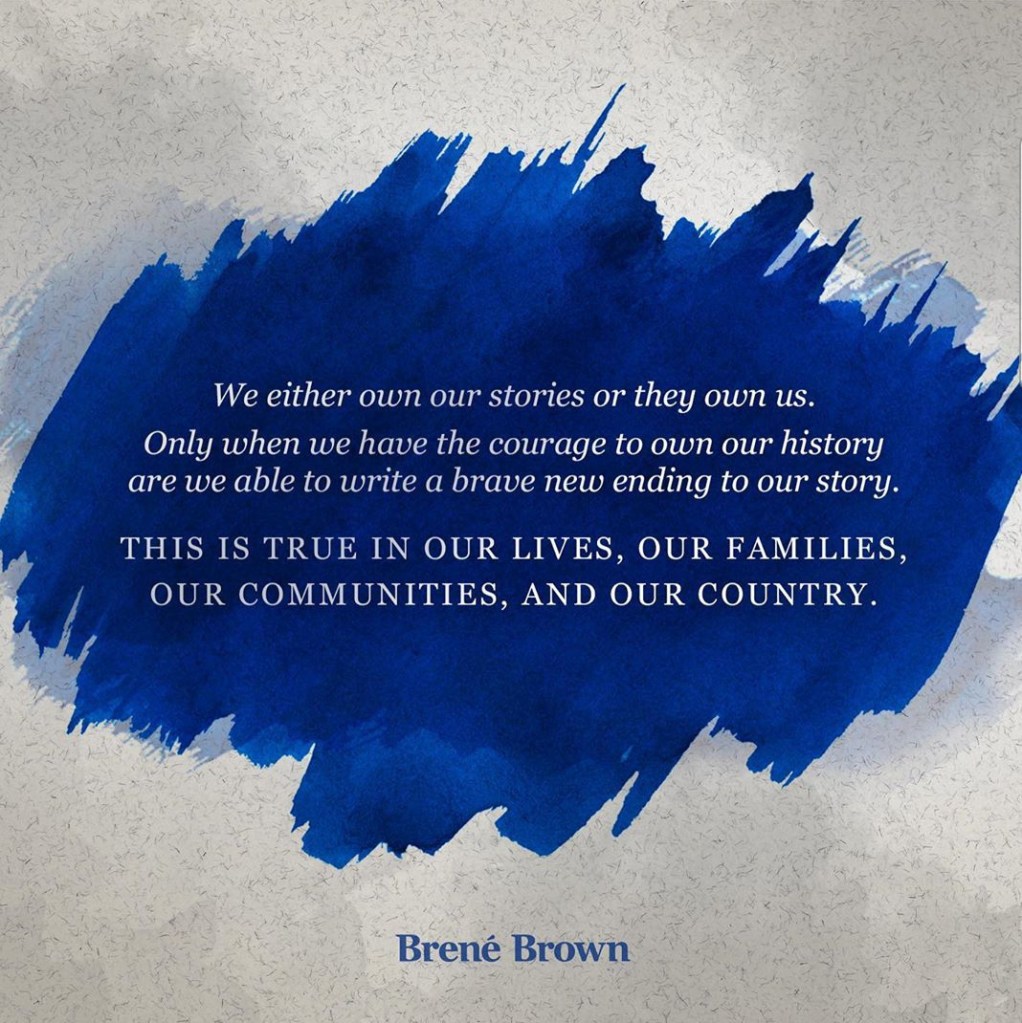
    Image from Facebook

    Brene Brown noted, “We either own our stories or they own us. Only when we have the courage to own our history are we able to write a brave new ending to our story.” I own my history of placating Whites at work, in friendship, and at church to make them comfortable with me. I also own that I previously believed that their comfort was more important than my being. BUT NOW (say it with me church)…I’m writing a very different ending for myself. It looks like loving myself enough to move forward with those who pursue justice in word and deed. Who continue to do the personal work of becoming anti-racist. It looks like loving myself enough to end fruitless conversations that originate with interrogation instead of empathy. It looks like CHOOSING. I now realize that as a Black Christian I don’t have to accept every invitation into a conversation on race. This makes me no less Christian. This makes me healthier. This makes me wise. This allows me to endure.

    If there ever was an anti-racist checklist, it would be loaded with nuance and complexity; joy and pain. Not a lot of conditional statements, but real expectations. It might look something like this.

    Anti-Racism Checklist

    1. Hard work
    2. Failure
    3. Love
    4. Ambiguity
    5. Frustration
    6. Anger
    7. Disappointment
    8. Endurance
    9. Victories (small & large)
    10. Lament

    Anti-racism is spelled M-A-R-A-T-H-O-N. It is not spelled p-o-p-u-l-a-r-i-t-y. Neither is it spelled p-r-a-i-s-e. To the adults in the room, we are not in high school anymore. Therefore, our personal metric should not be “cool by association.” No longer permissible to rest on the laurels of having Black friend(s) or coworkers. Stop searching for a list of things to “check off” to arrive at the status of anti-racist. A list of things to “prove” your work is not primarily performative. Don’t exhaust yourself trying to prove who you are. That’s wasted energy. Marathons are about conservation and bursts of energy at appropriate times.

    You know who you are and where you are. If you do not know who you are, honestly interrogate your soul. If you are not where you would like to be, then put in work. And keep working. But don’t ask me for a list. If you do, I will reference the one above. It is the only list I have that counts in this work. A list that allows us to examine our privilege, power, and prejudice.

    White people, if your relationships feel particularly strained with your Black friends or coworkers right now, remember, “ambiguity and disappointment” are on the list. If you feel exhausted, remember, “hard work and endurance” are on the list. If you feel like, you are just not getting things right, remember, “failure and frustration” are on the list. Black people, if you are tired of empty apologies and excessive validation, remember, “anger and lament” are on the list.

    If you have resolved to keep putting in work, then others will benefit from these acts of love and we’ll share in mutual victories. But, if your goal is simply to check off an act of love or a moment of endurance, you’ve missed it. Ball the list up. Throw it away and ask the question, “Do I really want to become an anti-racist or is this all for show?”

    “Search me, O God and know my heart. Try me and know my thoughts.” – Psalm 139:23

  • Lost that Loving Feeling

    Lost that Loving Feeling

    For the past ten days, each breath I’ve taken has felt triumphant and treacherous. In the same breath I would inhale hope and exhale despair. With as many breaths taken, I somehow still felt as if I was suffocating. A lingering heaviness remains in my chest, yet I persist in taking long, deep breaths of hope to survive. This is the only way I know to describe the unavoidable collision which occurs when the topic of racial injustice becomes a national (dare I say global) conversation and you live, work, or worship in a space where “White Gaze” is dominant or ever present.

    My time in Memphis has been unique, particularly in the new relationships developed; majority of my deeper friendships in this city are with white women. I am thankful for these women, but pandemics and protests have revealed that their love for me had better not be based on a feeling or we’re in trouble. Feelings alone won’t sustain a friendship.

    Unity feels good, when all appears good with the world. However, when people are protesting racial injustice in all 50 states and social media profiles are repeatedly highlighting the stories of #GeorgeFloyd and #BreonnaTaylor, those high and lofty feelings dissipate and we are left with the ugly truth of our bias. Sometimes our biases are stronger than our belief. Our belief in Christ and love of neighbor is superseded by an eye of interrogation of the Black life. “What did he/she do to deserve this?” Superseded by ideals of white savior-ism and notions of rescuing black friends from racism. “I don’t know what to do…just wish I could make all of this go away…” Superseded by complicit silence for fear of not “knowing what to say” or “having the right words.” “I really didn’t want to say the wrong thing to you as a white person, so I didn’t say anything…” Superseded by a strange premise that demonstration of love or support to a Black friend is different than that of a white friend. “You’re black…and I’m white…and…I just don’t know how to love you in this time.”

    The myriad of responses from many of my white friends during the most recent unrest caused me such sadness. I then began to ponder, when I have nothing to give emotionally, intellectually, socially, spiritually, (fill in the blank), will these friends still demonstrate love towards me? When we’ve lost that loving feeling, how then will Christ be glorified? When tears and pain are my constant diet and the warmness of presence you’ve known of me seems to be no more. When my enrage of of the devaluing of black lives is communicated will you see me as just another angry black woman? When I can no longer help you bear your burden, will you rise to help me carry mine? When I present you with the depth of my pain, will you rise and meet me in that space or will you retreat? When my actions don’t “feel” loving, will you still love me?

    I have one prayer during this time for my white friends and it is that you would rise. RISE to meet your black friends in this fight for justice. We are tired of hearing you say you just didn’t know what to say. Say something and be vulnerable in your humanity. We are tired of hearing you say it’s not your personality to say something. Courage is not about personality (ask this introvert). We are tired of hearing you say it’s hard. We know. YOU can do hard things. We are tired of you saying you just don’t know what to do. Educate yourself first. Listen (to Black people) second. Lastly act. We are tired of your excuses. It’s time to make moves. Join the movement.

    Recently, so many of my white friends, whom I love, have retreated if they weren’t praised for their actions (posts on social media, watching a documentary on race, etc.); if the pain was too great; if I didn’t initiate dialogue. After years of these types of conversations and consistent complicity from white christians from city to city, I almost decided to taper my expectations of white people during these times. I’ve decide not to do that. I will continue to push my white friends to live out the shared values of faith espoused.

    When our belief in Christ and love of neighbor is stronger than our bias, we will rise and not retreat. Our deep conviction to see the gospel manifest will drive our action in public and in private. Below, a dear friend of mine articulates what this exhaustion might look like.

    White christian friends, I am hopeful that your courage to stand for justice is a reflection of your deeper conviction (as a follower of Christ), not your desire for my validation as your Black friend. Some days I won’t be able to validate you because I am literally trying to catch my breath in this marathon of justice. Ask yourself – when the pressure increases (and it will), will you stop standing with me when I stop validating you? Only you can answer that.

    I don’t know what love feels like to you, but I do know what it looks like to me.  It looks like rising; a progressive upward movement towards the goal of justice.  Don’t run away from your Black friends when they are in pain.  That doesn’t look like love. Don’t ignore or try to escape from their pain. That doesn’t look like love. Don’t settle for inactivity in their pain. That doesn’t look like love. Be present. Be active. Be purposeful. The average number of breaths per day is 23, 040. Imagine exhaling despair that many times per day. It’s exhausting. I am are tired, but I won’t quit demonstrating my love for the marginalized. I hope you don’t either. Let’s do work.

  • Fresh out of Explanations

    Fresh out of Explanations

    “Not everything that is faced can be changed, but nothing can be changed until it is faced.”  – James Baldwin

    What an emotionally exhausting few weeks.  A time to lament the grave injustice of our “just-us” system in America.  It seems that justice is illusive for some and not others.

    Since hearing that officer Jeronimo Yanez was found not guilty and officer Ray Tensing’s trial resulted in another hung jury, my mind has not stopped racing with the myriad of thoughts about what’s continually communicated to people of color, in particular, Black men in America.

    Before I lament, I want to outline a few interesting facts about Philando Castile should give us pause as to whether or not he was being racially profiled.  #JustFacts. #Receipts.

    • Philando had been stopped by the police more time than the number of years he was alive.  He was pulled over 46 times prior to the last stop of his life at the age of 32.
    • Of the 47 times Philando was pulled over by police, only 6 of those stops were things that were observable from a police car – broken muffler or speeding.

    Here’s a little history of how much Philando had experienced being pulled over by the police prior to July 6, 2016: The Driving Life and Death of Philando Castile on NPR.

    The following excerpt from the NPR article gives an account of officer Yanez’s exchange with dispatch…

    Castile’s girlfriend, who was in the car, said it was because of a broken taillight. But in scanner traffic audio obtained this week by Minnesota Public Radio, a nonchalant officer, yet to be confirmed as Jeronimo Yanez, told dispatchers a different story.

    “Two occupants just look like people who were involved in a robbery,” he said. “The driver looks more like one of our suspects, just because of the wide-set nose.”

    Gloria Hatchett, an attorney for the Castile family, said that’s racial profiling.

    “How do you say, ‘There’s a robbery suspect with a broad nose, African-American?’ ” she said. “That’s equivalent to saying there’s a white woman with blond hair.”

    What happened next is unclear. Was Castile just reaching for his ID, or was he reaching for his gun?

    What we know is that Yanez fired his weapon.

    What we know is that throughout his life, Castile was stopped by police at least 46 times before that moment.

    If there was anyone familiar with the routine and perils of a traffic stop, it was Philando Castile.

    The July 6 stop was his last.

    Most know how this story ends; it’s practically predictable.  Police Officer shoots un-armed black male.  Police Officer is acquitted.  I needed space to lament and articulate the emotional distress I am feeling.  To name the ache in my heart.

    I lament that the life of a black male in America still hinges upon a white male’s determination of value.

    I lament that the humanity of black men is repeatedly stripped away when the “cause for shooting them” is because they are seen as violent, aggressive threats by default.

    I lament that I have friends who don’t see the err of today’s criminal justice system.

    I lament that black men can comply with police officers and still die.

    I lament that the trauma both Diamond and her daughter faced is deeply etched into their memories.  No 4 year old should have to console her mother for fear that she too will be shot by police.

    I lament that I am often asked to explain why an officer’s perceived fear does not make a black male worthy of death.

    explanation

    We use a subjective law (Stand Your Ground) to determine substantive matters (life and death).

    If you desire more explanations to ascribe value to the life of black men who are as much an image bearer of God as the men who shot them; miss me with that conversation.  I’m not having that convo today.  Probably not tomorrow. Probably not for a minute.  We have to change the starting line of this conversation.  Here me clearly.  I am fresh out of explanations if imago dei is not your starting point.

    In fact, it may be time for someone to explain to me why police officers are using body cameras if they seem to be of little benefit for the citizens?  Maybe, someone should explain to me why no one’s discussing the correlation of implicit bias and police shootings.   It’s a thing.  A very real thing.

    Isn’t it time to stop demanding an explanation and start acknowledging that the undercurrent of implicit bias has turned into a tidal wave?  This slow and silent killer is destroying families, disrupting communities, and traumatizing people of color daily.

    Isaiah 58

  • Unveiling Hidden Figures

    Unveiling Hidden Figures

    The movie “Hidden Figures” took me on a roller coaster of emotions that I am not sure I’ve come down from.  Many [many] years ago, I was a budding engineer interning at NASA’s Kennedy Space Center in Cape Canaveral, FL who later turned down an offer to work as a long term engineer there.   At that time I had no idea of the premise of being a “hidden figure” in my career.  I was naive. Hopeful.  Trusting and hanging on to every word of those in authority; predominantly  the older, white men who were my managers.

    This derivation of mixed emotions comes from the simple, yet complex idea that things which are hidden are searched for intentionally, or remain hidden for a long time; only discovered by happenstance.  I honestly celebrate the healthy exposure that this movie has brought African American women in the science fields, yet my heart and life experience wrestle with the reality that any leader who chooses to unveil hidden figures in any industry must pay some cost.  It may cost some a bruised ego.   Others some of their influence.  Still others the very position that they may have aspired to or felt entitled to for years.  Truthfully, this is a cost that some are unwilling to pay.

    ***SPOILER ALERT***

    Choosing to Unveil

    When I re-imagine the bathroom scene where her manager tears down the “Colored Only” bathroom sign with every exertion of strength in his body, I am deeply moved.  Viscerally moved to tears.  I am moved because he had a choice.  He had a choice to leave things the way they were (which was perfectly legal) or to ensure equity for all on his staff at the expense of his social capital and the dissenting opinions of others. I won’t divulge details, but as a women of color who has experienced working on teams and with management who choose to unveil and those who don’t, I will say that I believe this act was far more courageous than depicted.  Now, before we toot too many horns, the most glaring paradox in this movie to me was that these women WERE ONLY unveiled because there was a DIRECT BENEFIT to those who had allowed them to remain hidden for so long.  In fact, the cost became too great for them not to be unveiled.  I mean, we’ve got to get John Glenn to space, right?  By the end of the movie, I joined everyone in celebrating the greater victory for America, but I could only think, the managers cowered because they had to; because they wanted victory so badly.  They DID NOT do the right thing simply because it was the right thing to do.

    I want to honor Martin Luther King, Jr. as we near the end of another #BlackHistoryMonth and highlight the response of Dorothy Vaughan, Octavia Spencer’s character,  who in fact did the right thing because it was the right thing to do. 

    martinlutherkingjrthetimeisalwaysright

    Leaders who Do the Right Thing (as reflected in Octavia’s charachter) are marked by:

    1. Recognition (of others) – She actively worked to recognize the gifts and talents of those on her team even if it warranted a promotion for them and practical obscurity for her.
    2. Innovation – She  developed a new way for those on her team to experience growth so that they were prepared to be unveiled when the time was right.  She risked the very promotion she had longed for so that the entire team rose to another level when she rose to another level.  Great innovation is often accompanied by great risk.
    3. Golden Rule Gratitude – With outward expressions of gratitude, she never delineated from treating others the way that she wanted to be treated.
    4. Hopefulness – She hung on to hope.  Her hopeful vision for the future propelled her and others forward.
    5. Tenacity – She displayed a dogged tenacity to lead and develop others with the influence given.

    There are hidden figures in classrooms, colleges, and places of employment everywhere.  Many systems in society have given visibility to some and not others.

    Today, I am less of a hidden figure.  Still being unveiled and grateful for it.

    One day, I hope it is said of me that I “did the right thing” as a leader; a person of influence.  I understand that I have a beautiful choice.  I will choose to unveil hidden figures when presented with the opportunity. Who will you help unveil today?

    “He must become greater; I must become less.” – John 3: 30, NIV

  • Brothers Forgive Me

    Brothers Forgive Me

    This unsolicited request for forgiveness is long overdue.

    This cry for forgiveness is birthed out of a new revelation of the deep and damaging impact of mass incarceration on men of color; men of color like my brothers.  The brothers that I grew apart from long before we grew up because in their youth they experienced the dehumanization and desensitizing that happens upon incarceration.  I have been writhing with grief after watching “13TH” on Netflix.  This sense of sadness and shame that has come at the realization, that, I, your sister, have not advocated for you, my brothers.  My blood.  I’m sorry bros.  I love you bros.  I just didn’t know bros.

    This documentary on Netflix speaks of the loop hole in the 13th amendment which essentially provides a clause for criminals to continue to be subject to slavery or involuntary servitude.  The mythology of black criminology is pervasive in media and culture today, but it began long ago.  It is startling and disheartening how the narrative of slavery lives on in present policies and systems, cloaked under the guise of “criminal justice.”

    “We now have more African Americans currently under criminal supervision than all the slaves back in the 1850’s.”  – Senator Cory Booker

    This slideshow requires JavaScript.

    In the past, I shied away from watching TV series such as “Lockup” because these shows brought me incredibly close to some of the realities of those I love.  The brutality.  The identification by number not name.  The memories of visitations as a college student and beyond.  Remembering how unsettling it was to be frisked and undergo stringent visitation requirements.  Remembering the joy on your face and your warm embrace when I arrived for a visit.  Remembering the fear that came over me prior to every visit.  Fearing that I would be denied the opportunity to visit you.  Fearing that you were no longer allowed to see me.  Fearing something would always sabotage our brief connection.  And brief it always was.

    As we fast forward to the present, I am ashamed to state that I’ve had the same expectation of many who have no real context of what it means to be incarcerated and that expectation is to simply “move on after release.”  I remember the joy I had upon your release and I also felt quite lost because I didn’t know what to say or do.  At times that feeling remains.  You are an adult now.  And so am I.  You’ve experienced trauma for which I have no context, and sadly, I’ve expected you to simply bear that weight alone.  I’ve also expected you to easily navigate broken systems in our culture that express that although free, you are still not deemed a citizen.  Systems which prevent you from voting, exacerbate the cost of health care, increase barriers to employment, and multiply the cost of higher education.

    Forgive me for not acknowledging your pain.

    Forgive me for not acknowledging your victories.

    Forgive me for not using my voice and influence to not only advocate for proactive efforts that work to prevent young people from experiencing this trauma, but also advocate for young people who have been left to recover on their own after this trauma.

    Forgive me for not asking you how you were doing after release.

    Forgive me for moving on with life and expecting you to do the same.

    I am DEEPLY sorry.

    The physical chains remain in the transport of men and women into incarceration, but the mental chains are just as significant.

    On the eve of my 37th birthday, I am so grateful for lessons that my thirties continue to teach me.  The current lesson is to “keep learning.”  I am learning that my story, our family story is even more beautiful as I see the impression of your collective strength throughout it.   Your journeys have been incredibly difficult.  You guys have all continued to fight to be better men and good fathers.  Perfection is an illusion made for TV; I’ve yet to meet a perfect person.  You all could have thrown in the towel after each rejection post interview.  You didn’t.  You could have complained repeatedly.  You haven’t.  I know that your sons and daughters see you as heroes and so do I.  Thank you for displaying what it means to persevere.

    I am one who advocates for the marginalized; the outsiders, but I have been unknowingly callous to the implications of mass incarceration on our black men (brothers), our communities, our families.  I am still uncertain of how to advocate well.  I don’t know what I don’t know.  I am hoping that you all will become my new instructors.   I have so much more to learn.   So much more to learn from you.

    I love you guys.  Thank you for being gentle and patient with me in my ignorance.  It has taught me to do the same with others.

    Be completely humble and gentle; be patient, bearing with one another in love. Ephesians 4:2 [NIV]

  • Am I Black?

    Am I Black?

    20150611_123830“Am I Black?”  This question has echoed in my mind since it was so loudly projected from the mouth of a little boy (approximately 5 years old) to his parents as he sat with them and watched a portion of a video about the middle passage at The Griot Museum of Black Historyin St. Louis, MO.  The innocence and complexity of his question is what wrenches my heart.  In this beautiful world, it would be great if slavery never existed and if African American parents and those of other ethnicities never had to share with their kids the atrocity of their nation’s past.  In particular, their decision to treat certain people inhumanely.  This little boy could not understand why, in his own words, “only black people were treated this way…”  He actually asked his parents, “where are the white people?”  His mind could not process the reasoning behind the variation in treatment.  They spoke honestly and with lots of grace; not with malice or slander, but with love for their son and his tender, impressionable mind.  I am not a parent, but I commend these parents for walking gingerly with their son to help him understand his history and the importance of valuing all human life.  This indeed was one of the most precious moments I’ve experienced recently in our racially charged society that wants to dismiss the impact of years of oppression on people groups.

    For the past few days I have juxtaposed this little boy’s simple question with the recent events in Orlando, from the #PulseShooting to the shooting of #ChristinaGrimmie.  I love the city of #Orlando and I’ve been grieving with those in my hometown.  My community and people that I love and know are hurting deeply. We cannot understand the senseless act of these shootings.

     The beauty I beheld as this little boy asked this question was profound. You see, he didn’t “know” he was black because his experience as a little black boy was just as it should be.  He has not yet known what it is to be treated differently because of his skin color.  I am not sure that I want to wake him up from this dream.

    As a follower of Christ, I believe the church is called to make this child’s “ideal perspective” more of a reality, but we have to first deal with the sin in our own heart.  The reality that we just may be treating people differently because of their skin color.  Sunday is still a very segregated day in our nation.  The reality that we, the church, may be choosing not to get to know people because their lifestyle(s) don’t align with our beliefs.

    People are more than their ethnicity.  They are more than their sexual identity.  Oh that we would learn to live and love one another as people.  Not as pretentious, external, superficial, descriptors such as race, gender, and economic status.  This week in the wake of the Orlando tragedies I believe I was granted a gift from God to spend time in Colorado with a couple who co-founded a non-profit, which is making a difference in the lives of children who are aging out of foster care.  The gift for me was that although I “knew I was Black” in Colorado, I didn’t “feel” Black when spending time with their family.  I held tightly to this feeling because it was refreshing.  Typically, “feeling Black” when I am the minority means that I am treated as inferior and presumed weak.  To be in a community where I am clearly an ethnic minority (Colorado isn’t particularly racially diverse) and to be welcomed and loved as a person first, is a gift I treasure.  There might have been second glances from others as I sat around the table with this couple, their daughters, and a friend, at a local eatery, but at that table we laughed together and enjoyed each other’s company in earnest.  And although I am not their daughter, I felt protected by this couple in an incredibly beautiful way.  This was a dose of authentic love.

    If there was a gift that I could give to those who’ve experienced marginalization, it would be the gift of authentic love. To authentically love allows us to accept people as a part of God’s beautiful creation.  There is no doubt today that I am proud to be black.  But if I am honest, I have had to fight for this freedom of pride in my ethnicity, namely the darkness of my skin and kinkiness of my hair and all that I’ve been told that this represents in our western society.  What I have recognized recently is that fighting for freedom of an insecurity can be costly.  It can mean rejection from those that love you.  It can mean career assassination.   It can mean depression and sleepless nights.  I do not presume to understand the fight of those who are in the LGBTQ community.  What I do know is that I would like for #America and at times, those in the church, to stop making presumptions about their character and worth because of their sexual identity alone.  This is nonsensical.  Seriously.  We are people first.  Let’s treat each other as such.

    I grieve with all of the families whose loved ones lost their life during this tragedy.  I grieve with those in the LGBTQ community who feel the palatable weight of being targeted because of their sexuality.  I grieve with the family members of the shooter who may now be treated differently because of what he did.  I grieve for the christian church who has yet to learn that we all share a mutual brokenness as people; we are all in need of a Savior (Jesus Christ). Those who are black are in need. Those who are white.  Those who are heterosexual.  Those who are homosexual.  Those who are wealthy.  Those who are poor.  Those who are human are in need.  As we have a greater understanding of this need, we will lower our personal pedestals and stand together as people.

    “Be happy with those who are happy, and weep with those who weep.”  Romans 12:15

  • Prayer Isn’t a Placebo

    Prayer Isn’t a Placebo


    I’m guilty.  I’m guilty of treating prayer at times as if it is a placebo pill.  Placebo – a harmless, unmedicated preparation given as a medicine merely to humor a patient, or used as a control in testing the efficacy of another, medicated substance. At times, it has been easy to take “a dose of prayer” for a particular circumstance without sincerely believing that this “method of treatment” will be effective.  These moments of unbelief speak to my humanity.  There is no other intent of the placebo than for it to validate that the actual drug works well.  Selah (think about that).  Even the placebo points to the real thing. And even in my time of unbelief, God responds, reminding me, that He is the real thing and that praying in Jesus name is not a passive, powerless action.  You see, God isn’t encouraging us to pray, just to humor us with “one more thing to do.”

    Now, on to prayer and its power.  I have read several blog posts and comments [via social media] of people expressing anger or hopelessness at the state of our nation and then saying, “I’m tired of Christian people praying…”   “Don’t black people have have the right to hold a grudge over what happened in Charleston?”  “Why do we (Christians) always resort to prayer?”  When I heard this, something in my stomach turned because it seems that we have forgotten what the secret is in our secret sauce; IT IS PRAYER.  It is prayer to a God who is all-powerful (omnipotent), all-knowing (omniscient), and all-around (omnipresent).  Let me provide further clarity.  The main ingredient in our secret sauce of prayer is faith in a God who is faithful. Immutable.  So consistent, that he makes #StephenCurry free throws look inconsistent.  It is uncanny how much we can trust in ourselves and at times, how little we trust in God.

    Prayer isn’t a placebo.  It is the most powerful weapon we have in dismantling the work of the enemy when dealing with heart issues.  Beloved, some of the most daunting issues of our day are heart issues.   Injustice is a heart issue.  Racism is a heart issue.  Pride is a heart issue.  Lust is a heart issue.  Greed is a heart issue. Bottom line, sin is a heart issue.  All of these issues are presented with the possibility of mending by taking them to #thegreatphysician, Jesus Christ, and allowing Him to operate as He sees fit.

    Perhaps in all of the privilege we have in the world, the privilege to communicate with God directly holds no greater honor and no greater power.  This indeed may be the best “non-secret,” secret weapon we have as followers of Jesus Christ.  Let us not forsake this opportunity to commune with God.  To bring heaven into the ordinary.

    “As an instinct, prayer is a response to our innate but fragmentary knowledge of God.  It is like a note in a bottle to “whatever gods there be.”  As a gift of the Spirit, however, prayer becomes the continuation of a conversation God has started.  If that conversation proceeds, as in the best of conversations, praying becomes meeting with God – heaven in the ordinary.”  – Tim Keller, “Prayer”

    Prayer can be seen as a placebo if the action alone is not connected to the reality that God is with us. In us.  Desires to converse with us.  Be with us.  It is no different than a parent than desires to know, really know, how their child is doing.  At times, the parents may already really know what’s going on, but they see the opportunity for much deeper connection with their child as they are allowed to simply bring the concerns of their heart to their parent and leave them there.  The greater hope we have is that as we present our concerns to God, He listens, and He always responds with our best interest in mind.  Sometimes His response is yes and other times it is no (or “not right now”); but, it is the best response for us at the time.

    I have seen the hearts of men and women (even my own) change through prayer and force-ably tackle heart issues.  In a previous blog post written, Just Cry – Tears for Charleston and the Black Community, I exhorted people to simply allow grief to be a first step in the healing process regarding the #charlestonshooting.  I believe prayer is a close next step.  Whenever that next step happens for you.  As a Christian, prayer positions us to respond in a way that glorifies God.  This may cause repentance, righteous indignation, or respectful dialogue for some.  Prayer powerfully moves us away from bitterness and closer to reconciliation.  No placebo at all.  In fact, quite effective in producing change.

    Prayer may appear passive, but don’t be fooled, it packs a powerful, “one, two…punch.”  Prayer is teaching me the wisdom in speaking to God first in order that I might more effectively speak to others.

    “We use God’s mighty weapons, not worldly weapons, to knock down the strongholds of human reasoning and to destroy false arguments.” 2 Corinthians 10:4 (NLT)