
Tag: trauma

  • Divine Heartbreak

    Divine Heartbreak

    Two years ago, my aunt died. Five months after that my younger brother died. Both of these deaths were unexpected and sudden. Shocks of heartache I was unprepared for. And would you believe it, that six months after my brother’s death there was yet another life altering AND miraculous event which left me unemployed and the primary caregiver for my mother? Waking each morning my soul shutters at the weight and wonder of it all. My heart has been aching for a while now. I’ve been most intrigued by the reality that this HEARTACHE was authored by God. This blog is to memorialize thoughts that I have internalized over the past year and a half. Thoughts and feelings as I continue to navigate this roller coaster of grief.

    phase one of heartache

    On the day my mother lost a son, she also lost a daughter whose identity was hijacked by the role of caregiver. I became hyper vigilant on providing excellent care to her as she prepared for a lung transplant. All I knew is that I could not lose her too; as if I had any control over that. I exerted all of my effort to support her as an overcompensation for my inability to support my brother (as I desired) in his last days. In the depth of my soul I believed that if I was in a hospital bed fighting for my life, my brother, Ken, would not have been pulled from my side. Our love for one another was a deep well. However during this time of duress, I failed him. I could not be by his side. I lament this often. Maybe I would have more closure if my last memory was holding his sweet hand as he gasped for his last breath. Circumstances and my shattered heart kept me from being there. It is my greatest regret.

    So yeah, when my mom lost her son, she lost me (as her daughter) in many ways. For the past year or so, I have been trying to find my way back home. I have spent majority of my life as a woman of faith, experiencing God’s protection, provision, and presence. The deep ache in my heart hasn’t prevented me from running to God, but it has caused me to have questions for God, doubt the goodness of God, and long for days when I could easily trust that all would be well. Give me that easy like Sunday morning trust. Gone are those days.

    This heartache is different because it lingers in the morning and at night. It lingers as I work out and as I rest. Long-term heartache equates to heartbreak. I often tell close friends that grief changes us. I can not name all the ways it has changed me, but I know that I am changed. So when you see me, your encounters will now have to encounter my grief, angst, and sadness on some days. Please don’t ignore that – just be present with me. Without questions or advice.

    phase two of heartache

    Even in the midst of my doubts of the Lord’s goodness, He would arrest my heart with gratitude by opening a door for my mom’s transplant six months after my brother’s death. I was elated and even surprised at the timing of the transplant. Nothing could have prepared me for the next round of heartache when I almost watched my mom die. The transplant went well, but a few days afterwards there was trouble in paradise. I watched as nurses and doctors worked to revive my mother – a memory that never leaves you. The myriad of complications post transplant left me no choice but to delay returning to the classroom as an educator.

    During this phase, more of my heartache grew as we returned home and all routines changed. I changed. In phase two, our home became synonymous with caregiving and nothing else. Medications, tube feedings, vital checks, breathing treatments, cooking, and cleaning. Because of the seriousness of my mom’s needs during this time, my body became conditioned to watch for and respond to every single concern. I jokingly referred to myself as her unpaid nurse from time to time.

    It has been one year since my mom’s transplant and she is doing amazing now. Our family is filled with gratitude. What I have realized is that my body is filled with trauma. I hold in my body so many moments of grief and tragedy and unfortunately my body still wants to operate as caregiver and not daughter. My body recalls the beeps from the tube feed machine in the middle of the night and hoping that it hasn’t gotten clogged or pulled out warranting yet another trip to the hospital. Each night I lay down prepared to rise suddenly if needed although my mom is doing well. This is the heartache. When I sleep, I am still sensitive to any cough or noise from my mother. Any day if something is slightly off. I experience less moments of laughter and joy because my energy is consumed with “making sure she is ok.” My eyes and ears have been trained to look for things that are possibly, even subtly, wrong. I had to do this daily for so long because little things that were slightly off became big things. Now I do this instinctively. This is heartache. This can be helpful, but unhealthy if it there’s no “turn off” switch. I presumed leaving the caregiver role behind would be automatic for me and it hasn’t.

    So now I speak to those of you who have been caregivers for your parents (or a loved one) during a season of life. I imagined myself immediately “living again” after my mom’s health improved, yet I find myself stuck. Stuck in a role that was divinely orchestrated and has rewired my interactions with my mother. I have been told by those on the transplant team that the first year of this journey can be really unpredictable and difficult. I look forward to returning to the classroom this year and hope that God will grant me wisdom as to how I can better care for myself. I desire to move out of the caregiver role and return to daughter. I welcome input, insight, and invites for coffee during this transition.

    My heart was broken and is in repair due to God’s sovereignty. My prayers were not answered in a way that I desired, but they were answered.

    Now, I long for God’s presence in the midst of the heartache for it has been the only remedy with staying power. Maybe that was God’s plan all along – more of Him and less of me.

    Today I remain full of hope with a heavy heart as my remnant.
  • Invisible Scars

    Invisible Scars

    It is the third quarter of the school year and I am scarred. I look the same on the outside. What has happened to my soul is undetectable to the human eye, but I AM SCARRED. As a proud Black woman from the south, I have traditionally looked for scars on the exterior of my body; perhaps they would show up in physical form. This time they have mostly been internal. My thoughts race with “what if” scenarios that spiral out of control. What if another child is shot? Can my soul bear that news? What if another parent has to bury their child? What if I have additional sleepless nights with recurring sound clips of grief deeply laden within a parents voice. What if…

    A few weeks ago, I learned that a 9 year old student at our school had been shot while playing outside. He did not survive. He was just playing with his siblings and family. It was nearly 6 o’clock in the evening and the sun had just gone down less than thirty minutes prior. Earlier in the school year, a 7 year old student who attends our school was hit by gun fire when someone shot into their home. In both cases, I have older siblings of each student in my 5th grade class.

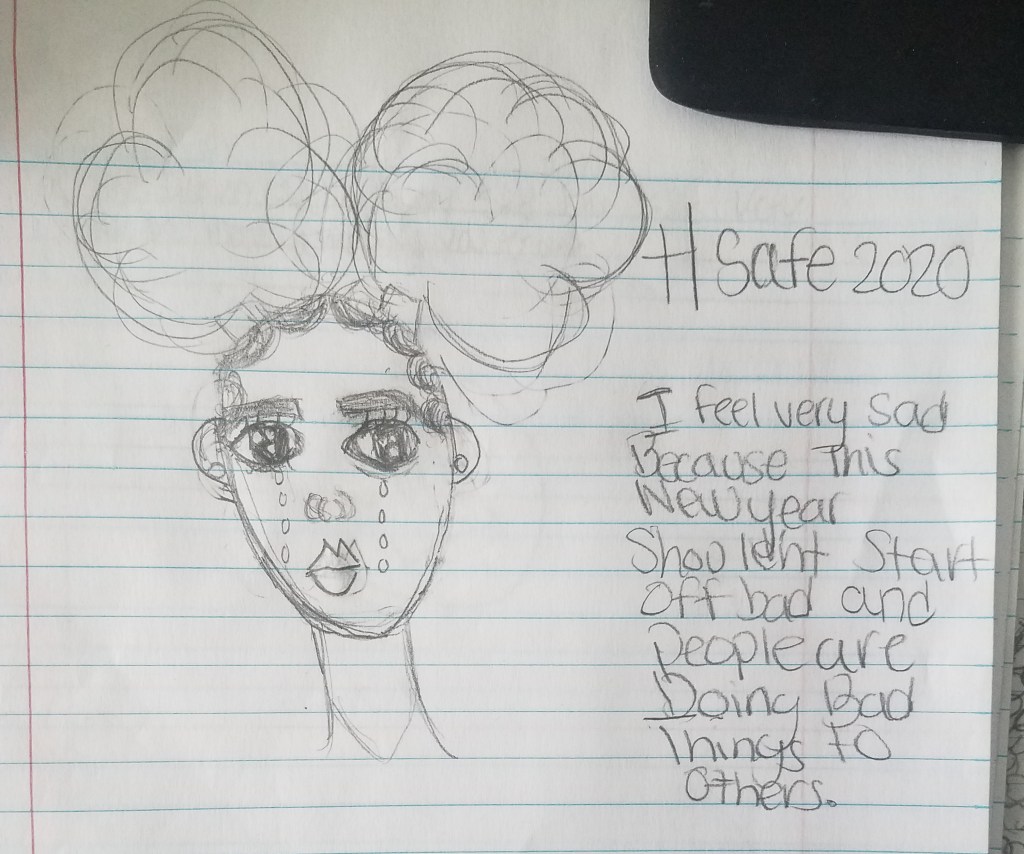
    As my students and I spent time trying to process our feelings through writing, drawings, and tears, I was unprepared to hear of how many additional stories of gun related trauma they had encountered. For the past three weeks, my soul has been overwhelmed with grief. I enter the school building and tears have flooded my eyes. I have no regret with the choice I have made to teach in this community. It is one of my greatest honors, however, I wasn’t prepared for this type of loss. I wasn’t prepared for the shattering of my soul as I walked through the hallways thinking about what my student would experience when she returns knowing these are the same hallways her brother often walked down. As a person who likes to have answers. I have none. I have been giving hugs. Lots of them. I have been honestly sharing with my students and other teachers how this grief has impacted me. I have also decided to seek professional help. I am looking for a Black therapist in my area who can help me process.

    There are times when our souls are enlarged through suffering. Supernaturally or divinely, we are able to experience or relate to God and others in a new way through suffering. At this time, my soul doesn’t feel enlarged through suffering. I just feel lost. I’m teaching, but I feel deep sadness daily. Sad that a little black boy was shot down in the midst of black joy. Sad that my students expressed that they don’t feel safe in their community. Sad that the siblings of this student have experienced such loss so early in life. Sad that I can only support students in limited ways. Sad that our western society cries out that we must continue to educate our children in the midst of tragedy. Just keep teaching. I am sad that we are sending them a message far too early in life that when your heart aches, when loss grips you, when depression overtakes you; don’t lament, just work. Don’t cry; just work. Don’t slow down; just work.

    This sudden loss triggered the trauma I experienced as a sixteen year old when I received the news that my dad had passed away. I remember how helpless I felt returning to school the next day. Yep, I went right back to school. It was one of the safest places I knew and it brought me great joy. I remember being afraid to share with friends or teachers that my dad was dead. I remember how much relief it brought me to have a teacher point to a name in the obituary and ask…”Was this your father?” I was relieved that someone else knew and cared. Honestly, what teacher reads the daily obituary looking for student names? That teacher understood the experiences of my neighborhood and the trauma my classmates and I encountered. I remember simply answering “yes” and not having the resolve to say much more.

    As a teacher working in a similar neighborhood as that of my childhood, I now realize that the invisible scars from my youth in addition to those incurred this year can do immeasurable damage to my mental and physical health if I am not honest with myself. If I don’t seek help. If I don’t take time to grieve. I’m doing that ya’ll. I’m taking mental health days. I’m slowing down. Taking the deep breaths. Increasing my gratitude. Loving those around me. Loving myself. Asking God for insight/wisdom each day in the classroom. My greatest partnership is with the Holy Spirit as I teach. I know I am not in the classroom alone and lately, God’s presence has been palpable and I’ve needed that. I am so grateful for friends that have stopped by my classroom to give me the best hugs; no words, just a warm embrace reminding me that I am cared for. Grateful for friends and family who have called to hear my voice and ask me if I am okay. Grateful for friends who have encouraged me to take the mental health day(s) necessary to care for my soul. Grateful for friends who have brought me freshly baked cookies and sweet notes that lift my spirit and my energy. You all should know, that although my head is not fully lifted and days are still cloudy, your acts of kindness and care have sustained me.

    I wanted to write this particular blog to encourage my friends who work in industries of service (social work, health, education, etc.) to be just as vigilant about your mental health as some of you are about your physical health. They are inextricably linked. And lastly, because this is Black History Month and we (black people) have a history of falsely believing that we can carry EVERY burden and NEVER ask for help, this post is for you. Friends, take care of yourself. Take care of your souls. Don’t carry burdens that were not yours to carry alone. Don’t let your invisible scars manifest as physical scars. Both are painful. Let’s work to minimize our scars.

    After you read this post, I don’t want your pity or praise, just your prayers and presence. Just your commitment to take care of yourself before you try to take care of others. I have chosen to teach in a community that experiences high trauma and some tragedy. It is still one of my greatest joys.

  • on the other side

    on the other side

    Imagine what it’s like to be stuck in a reality that dismantles your family, presumes your guilt based on your God-given gear ( I’m talkin’ skin color), and leaves you with a thousand sleepless nights and I will tell you what it’s like to have a Black son, brother, husband, father or friend to undergo the unwieldy American unjust justice system. Key word here is REALITY. For some the account of When They See Us by Ava DuVernay is philosophical and conversations loom around poetic pros and pithy arguments, yet I am unable to escape the striking resemblance to my family’s reality of justice gone wrong.

    So many images from this series are seared into my psyche but none more piercing than that of a pride so deep that produces prejudicial action. This is the stuff of oppressive systems. My stomach turned in knots as I realized that when they (Whites) see us, they remember her (White investment banker brutally raped). How could they not? A judge, who like most, keeps a doting picture of his (White) wife on the bench; a young, White female prosecutor; fill in the _____________. A quick substitution of the rape victim with the face of the one they love and the five black boys on trial are no longer seen as such, but as a wolf pack to protect their loved ones from. This instinctive ability to re-imagine ourselves or a person we love/care about that has been victimized is all natural. Development of my empathetic muscles has come from a place of love through proximity. So, I’ll say it – love differently ya’ll. Love different people from different places of different races with different experiences and I am certain you will no longer see a wolf pack. You’ll see a student, a friend, someone’s brother, a child, a person.

    http://www.glamour.com Atsushi Nishijima/Netflix

    On the other side of incarceration there are parents, siblings, children, friends who experience loss from a system designed to keep so many bound.

    When They See Us not only exposes what happens when justice moves away from righting wrongs to jockeying for power, but also depicts the complex choices of those “on the other side.” It highlights how the pressures of our penal system forces parents to choose between provision and purported protection. Complicated.

    Antron’s dad lost his son trying to protect him. Raymond’s dad would forever regret sending him to the same park where he would be targeted by police. Kevin’s sister is crushed by her 14 year old brother’s tear-filled plea to simply return home and signs a coerced confession. Complicated. Somehow through deep loss and grief, those on the other side are able to beautifully uphold the dignity of those they love. While it is painfully obvious during each episode that whiteness affords many the privilege of a better trial than their Black counterparts, I found a few other lessons embedded within.

    Clinging to normalcy: the return home. The return home is anti-climactic. Fathers unprepared to receive the sons they’ve betrayed by choosing absence on court dates. Sons bravely clinging to normalcy found in the days of old. Holding tightly to the culmination of belongings in a brown paper bag. Dreaming nightly of the return home only to realize that the heart’s deep love must now sync with the awkward moments of freely being present with loved ones as the muscle memory of trauma reminds everyone to restrain affection and the expression of feelings. Trauma makes normal abnormal. We must be gentle with one another.

    We are not okay: lying to survive The penal system can produce a family of pretenders. We all pretend that everything is okay post incarceration. Because how do you even begin to process that all involved have less hope in a justice system that doesn’t value our Black lives or legacy? Korey’s mom would ask him, “What is it like for you in here? Are they treating you okay?” His response was always, “I’m surviving…” or “I’m holding it down…” Responses which are echoed all across America. We may never know the entire story of someone’s trauma. For those that choose vulnerability, let them do so in their own time and in their own way. We must be gentle with one another.

    “I’m just a shadow,” says Korey Wise, one of the exonerated five and victim of horrific beatings. “I’m very empty — 46 years old and empty. At the same time, I’m talking to the kid in me: ‘I got you, baby boy. Nobody can take your story from you.’”

    Real love…I’m searching for a real love…someone to really see me. (cue Mary J. Blige song) It is real love that slowly shifts our gaze beyond bias and towards humanity. Love is less about whimsy, more about choice. It is an outright intention to choose another over yourself. It is sacrificial at it’s core. Consider those on the other side of incarceration (or providing trauma support) and ask yourself, how have I loved them? These parents, children, siblings, loved ones are often left in the shadows. Those who’ve directly experienced trauma and those supporting them need that real love.

    “All I do all day long is LOVE YOU.” — Mother of Antron McCray, one of the exonerated five boys.