Tag: hope

  • Answerless Hope

    Answerless Hope

    The more complex my life circumstance, the less complex my prayers. More of Him. God with me. Less of me. Words fail. Presence succeeds every time. Keep me near thee, oh God. Those few lines sum up last year. Simple prayers. Deep lament. I’ve found depth in brevity; the closeness of God in times of deep sorrow. Gratitude has been an anchor for my grief preventing me from drowning in the trauma that was the year 2020.

    I have so many unanswered questions for an omniscient God. Why did my father die due to addiction? I was only 15. His addiction caused him to separate from our family when I was 2. Why did I grow up in poverty? Why did you give me THE BEST mom? A mom who lost both parents by the age of 35, yet parented and loved me so well. Why wasn’t she afforded the joy of experiencing the parent/child relationship with her mom? Why have I been a single woman for so many years? These questions may never be answered, but I am not without hope. How can I have hope without answers? I have spent the past 7 months pondering the power of hope when answers are few and why love is an even greater power than that.

    Hope doesn’t demand answers, yet longs for them. Hope requires possibility. If it is to sustain ones soul, it demands truth, something substantive to hold on to. I learned this summer that hope without truth is denial. I repeat. It does not demand answers. Possibility may prove more powerful than the answer itself. Hope’s power resides in the belief of possibility.

    The power of this principle was magnified last August when my mom became suddenly ill and subsequently tested positive for covid-19. This news sent rage, anger, and fear quickly through my body. With her pre-existing condition and age, I prepared for the worst and flew home to be present. Every news article and report I’d seen became much more than a story. Unable to see her – no hospital visits allowed. Unable to hear her – she could barely breathe let alone speak. Unable to comfort her through proximity. Unable to pray pithy prayers, I became deeply acquainted with simplicity. God, I need you. My mom needs you. During the day I busied myself caring for and supporting my mom and family anyway that I could, but at night I cried and cried and cried. It is no exaggeration to say that tears became my food day and night. Each day brought uncertainty; never before had I stared despair in the face and fought like ___ for hope. Go ahead and fill in the blank; yep, that’s how hard I fought for hope.

    In my humanity, I often wanted God to just tell me if my mom would live or die. I wanted finality, but God offered none of that, yet each day, I had enough hope to sustain me. And just like manna, hope fell daily and provided just what I needed. Hope holds us in our suffering and even soothes our souls – providing divine levels of comfort and perspective to fuel our persistence in prayer, justice, or relationships. Without hope the long haul is just long suffering. Hope leaves us longing, but love answers. Love says yes or no and the answer is always for our good. And this may be why love is more powerful. “Hope deferred makes the heart weak,” is a proverb I’ve held on to for years. To be in anguish for days, months, or even years with concern for the well being a loved one has a way of weakening the heart. When love answers, we may celebrate, grieve, or find ourselves somewhere in between. Love’s response allows us to eventually establish new hope.

    In December 2020, a dear friend of mine lost her father due to complications from covid-19. My nightmare became her own. While my mom survived the brutal effects of covid-19, her dad did not. The very thing I feared became her reality. I am still reeling from this loss. Truthfully it’s because I had such great hope in God. I know he is capable of healing. My hope was not misplaced, but my heart wasn’t ready for Love’s answer. This was one of the hardest no’s from God this year. I live with the loss of my father daily; the vacancy in my heart that longs for his physical presence is irreplaceable. I am well acquainted with this pain and I wish no child experienced it.

    2020 was the hardest year of my life and it is not lost on me that the multiple valleys brought exceptional clarity about what’s most important. I didn’t expect corrective vision to come in this fashion. Some things remain blurry and unanswered. I can long for answers and remain hopeful. Such is a paradox of life. “On Christ the Solid Rock” is a hymn reminding me of this longing. A portion of that hymn is below.

    “My hope is built on nothing less
    Than Jesus’ blood and righteousness
    I dare not trust the sweetest frame
    But wholly lean on Jesus’ name

    On Christ the solid rock I stand
    All other ground is sinking sand
    All other ground is sinking sand

    When darkness veils his lovely face
    I rest on His unchanging grace
    In every high and stormy gale
    My anchor holds within the veil

    His oath, his covenant, his blood
    Supports me in the ‘whelming flood
    When all around my soul gives way
    He then is all my hope and stay”

    John Onwuchekwa of Four in the Morning podcast said, ” Life is lived at the intersection not the freeway. Life will stop you at some point. Processing grief is a skill. It is not about time. Grief is not a pest to be exterminated.” Life certainly stopped me in 2020 and forced me to acknowledge loss. I am hopeful to live 2021 at the intersection of grief and gratitude. Both are powerful. Both allow me to reckon with loss and revel in victory. Resilience is born in this place. None of us are without loss and all of us have something for which to be grateful. The inextricable connection between hope and love has helped me to move through last year and will provide foundation for the new year.

    Last year’s personal trauma introduced so many new questions for God, but I am not without hope. I will bring those questions to Him in the quietness of the night. I will inquire of him when doubt is amiss. My soul will ask him to answer me especially when grief overwhelms me and words fail. I will remain vulnerable in angst and joy. I know he will answer. God is love and love always answers.

    “So now faith, hope, and love abide, these three; but the greatest of these is love.” – 1 Corinthians 13:13, ESV

  • Anti-Racist Checklist

    Anti-Racist Checklist

    Full lips, round hips, black skin is where I begin, but not where I end. – Black woman.

    It’s July 2020 and suddenly America has awakened to a realization that Black lives should matter in these United States. Operative word should. Just a few days shy of July 4th and Breonna Taylor’s family along with so many other Black families are aghast with performative measures of alliance and yet no substantive change. No arrests for the police officers who shot her while sleeping. SLEEPING. The message being communicated to Black people hasn’t changed; we say that we are with you, but our systems remain the same. Our systems don’t support your thriving and barely support surviving. Enter the work of anti-racism.

    It is unlikely that anyone can scroll on social media or watch mainstream news in recent weeks without some story or post discussing systemic racism or what it means to be anti-racist. I’m encouraged to see the proliferation of Black voices and the elevation of our story. I am also noticing some fatigue from White allies – we’ve only been having this global conversation on race for 1 month. 30 days. That’s it. When fatigued, it is likely that we will reach for the easiest possible solution and to some that looks like an anti-racism checklist. An insensitive move, in jest, to ask your Black friends to tell you a list of things you should do to be considered anti-racist.

    This ask has come as a direct and indirect proposition. It may sound like “I wish I just knew exactly what to do” or “I just want to show you that I am anti-racist.” A list sure would make things easier. To those beckoning for a list, I agree, that is way easier. However, EVERYONE is more complex than a list of “to dos.” Your most valued relationship can not be deduced to a list. When I think of an anti-racist list, I simply hear another request for comfort. Another request for me to acquiesce to your discomfort. I will not do that anymore. For centuries, the standard for Blacks has been unreasonably high (perfection before dignifying) and the standard for Whites shamefully low (accommodation of comfort).

    Anti-racism does not ask me to shrink my voice, presence, or pride (in my Blackness) for your comfort.

    Precious Jones

    I’m not asking your forgiveness to live in my fullness. For so long I’ve chosen to shrink parts of my ethnic identity to make White people, especially White Christians, comfortable. Always learning more about their culture. Always accommodating comfort. Executing survival tactics such as code switching to climb the corporate ladder and regrettably leaving parts of me buried below as I moved up. For decades there was very little love for this brown skin girl. I’m realizing that choosing between my ethnicity and Christianity is a false choice. I’m certain that Christ wants me to live fully Black AND fully redeemed; not some reduced version of myself. Else, why would God create humanity and allow our eyes to differentiate color variants if there was no intention for us to see the beauty in difference? At what point did beauty become a point of division? Don’t answer that. I repeat. Don’t answer.

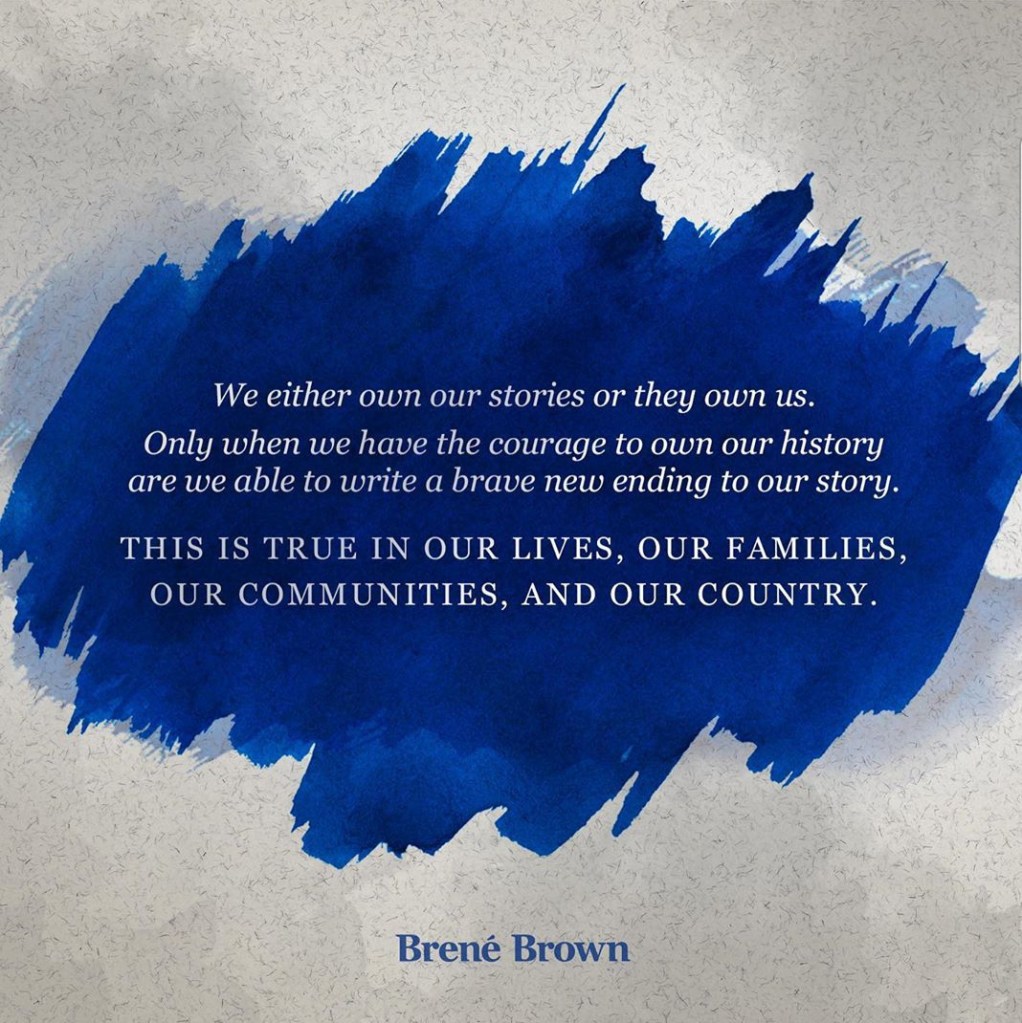
    Image from Facebook

    Brene Brown noted, “We either own our stories or they own us. Only when we have the courage to own our history are we able to write a brave new ending to our story.” I own my history of placating Whites at work, in friendship, and at church to make them comfortable with me. I also own that I previously believed that their comfort was more important than my being. BUT NOW (say it with me church)…I’m writing a very different ending for myself. It looks like loving myself enough to move forward with those who pursue justice in word and deed. Who continue to do the personal work of becoming anti-racist. It looks like loving myself enough to end fruitless conversations that originate with interrogation instead of empathy. It looks like CHOOSING. I now realize that as a Black Christian I don’t have to accept every invitation into a conversation on race. This makes me no less Christian. This makes me healthier. This makes me wise. This allows me to endure.

    If there ever was an anti-racist checklist, it would be loaded with nuance and complexity; joy and pain. Not a lot of conditional statements, but real expectations. It might look something like this.

    Anti-Racism Checklist

    1. Hard work
    2. Failure
    3. Love
    4. Ambiguity
    5. Frustration
    6. Anger
    7. Disappointment
    8. Endurance
    9. Victories (small & large)
    10. Lament

    Anti-racism is spelled M-A-R-A-T-H-O-N. It is not spelled p-o-p-u-l-a-r-i-t-y. Neither is it spelled p-r-a-i-s-e. To the adults in the room, we are not in high school anymore. Therefore, our personal metric should not be “cool by association.” No longer permissible to rest on the laurels of having Black friend(s) or coworkers. Stop searching for a list of things to “check off” to arrive at the status of anti-racist. A list of things to “prove” your work is not primarily performative. Don’t exhaust yourself trying to prove who you are. That’s wasted energy. Marathons are about conservation and bursts of energy at appropriate times.

    You know who you are and where you are. If you do not know who you are, honestly interrogate your soul. If you are not where you would like to be, then put in work. And keep working. But don’t ask me for a list. If you do, I will reference the one above. It is the only list I have that counts in this work. A list that allows us to examine our privilege, power, and prejudice.

    White people, if your relationships feel particularly strained with your Black friends or coworkers right now, remember, “ambiguity and disappointment” are on the list. If you feel exhausted, remember, “hard work and endurance” are on the list. If you feel like, you are just not getting things right, remember, “failure and frustration” are on the list. Black people, if you are tired of empty apologies and excessive validation, remember, “anger and lament” are on the list.

    If you have resolved to keep putting in work, then others will benefit from these acts of love and we’ll share in mutual victories. But, if your goal is simply to check off an act of love or a moment of endurance, you’ve missed it. Ball the list up. Throw it away and ask the question, “Do I really want to become an anti-racist or is this all for show?”

    “Search me, O God and know my heart. Try me and know my thoughts.” – Psalm 139:23

  • New Hope

    New Hope

    Money can’t buy you love, but it can buy you justice. This position is not one for arguing – today’s contention is how to ignite hope in a community that has seen it’s dream of equality shot down decade after decade. Not false hope. Not pipe dreams. So far, this is the type of hope that generations of Black Americans have been given; false premises of being seen, heard, and valued. Unfortunately this view also permeates classrooms. Dreams devoid of hope vanish into thin air leaving it more difficult to breathe for all of us. Gasping for a hope that seems to evade.

    I was unprepared for the reckoning my heart would face when I watched the movie Just Mercy. I read the book a few years ago and was wrecked by Bryan Stevenson’s compelling proposition to be proximate to the poor if you want to see change (in yourself and larger systems). I made moves. Became proximate. But let me tell you, when this book was brought to life on the screen, I could only see two things; black men in my family and the black boys in my classroom. I was unable to shake the reality of how so many of their dreams vanish into thin air early. Historically, the criminal justice system presumes guilt before trial and the classroom deems incompetent before demonstrating capability. As I wept in that theater over and over again at real lives who were deemed to have zero meaning, I asked myself about the power of hope to fuel justice.

    Hopelessness is the end of justice. – Bryan Stevenson

    This movie reminded me of the power of knowing you have someone in your corner fighting for you. The power of knowing that someone believes your life has value. The power of knowing that you aren’t the only one who hasn’t given up hope. The power of knowing what it feels like to receive mercy. The power of proximity to drive empathy-fueled action.

    I have chosen the classroom as a place to restore hope. It is the most difficult thing I have done. It is complex and nuanced. No parent or child is the worst thing they have ever done. Each child I behold not only bears the image of God but also the hopes of their parents; their people. I get that. I know what it is to have the dreams of your family resting on your shoulders. When my students are older, I hope they know how much I fought for them. I hope they know how much I loved them. I hope they know how much I valued them.

    There are lots of lessons to learn throughout the course of a school year, but I hope to infuse students and the families I serve with new hope. A new hope which restores truth to a generation of black and brown children who have been told that they are incapable. All children are capable of learning. All children are worthy of love. This blog is more of a note-to-self. May I always stand in these truths in the classroom.

    “I got my truth back…you gave that to me. Ain’t nobody gone take that from us.” – Walter McMillian [Just Mercy]