Tag: Grief

  • Divine Heartbreak

    Divine Heartbreak

    Two years ago, my aunt died. Five months after that my younger brother died. Both of these deaths were unexpected and sudden. Shocks of heartache I was unprepared for. And would you believe it, that six months after my brother’s death there was yet another life altering AND miraculous event which left me unemployed and the primary caregiver for my mother? Waking each morning my soul shutters at the weight and wonder of it all. My heart has been aching for a while now. I’ve been most intrigued by the reality that this HEARTACHE was authored by God. This blog is to memorialize thoughts that I have internalized over the past year and a half. Thoughts and feelings as I continue to navigate this roller coaster of grief.

    phase one of heartache

    On the day my mother lost a son, she also lost a daughter whose identity was hijacked by the role of caregiver. I became hyper vigilant on providing excellent care to her as she prepared for a lung transplant. All I knew is that I could not lose her too; as if I had any control over that. I exerted all of my effort to support her as an overcompensation for my inability to support my brother (as I desired) in his last days. In the depth of my soul I believed that if I was in a hospital bed fighting for my life, my brother, Ken, would not have been pulled from my side. Our love for one another was a deep well. However during this time of duress, I failed him. I could not be by his side. I lament this often. Maybe I would have more closure if my last memory was holding his sweet hand as he gasped for his last breath. Circumstances and my shattered heart kept me from being there. It is my greatest regret.

    So yeah, when my mom lost her son, she lost me (as her daughter) in many ways. For the past year or so, I have been trying to find my way back home. I have spent majority of my life as a woman of faith, experiencing God’s protection, provision, and presence. The deep ache in my heart hasn’t prevented me from running to God, but it has caused me to have questions for God, doubt the goodness of God, and long for days when I could easily trust that all would be well. Give me that easy like Sunday morning trust. Gone are those days.

    This heartache is different because it lingers in the morning and at night. It lingers as I work out and as I rest. Long-term heartache equates to heartbreak. I often tell close friends that grief changes us. I can not name all the ways it has changed me, but I know that I am changed. So when you see me, your encounters will now have to encounter my grief, angst, and sadness on some days. Please don’t ignore that – just be present with me. Without questions or advice.

    phase two of heartache

    Even in the midst of my doubts of the Lord’s goodness, He would arrest my heart with gratitude by opening a door for my mom’s transplant six months after my brother’s death. I was elated and even surprised at the timing of the transplant. Nothing could have prepared me for the next round of heartache when I almost watched my mom die. The transplant went well, but a few days afterwards there was trouble in paradise. I watched as nurses and doctors worked to revive my mother – a memory that never leaves you. The myriad of complications post transplant left me no choice but to delay returning to the classroom as an educator.

    During this phase, more of my heartache grew as we returned home and all routines changed. I changed. In phase two, our home became synonymous with caregiving and nothing else. Medications, tube feedings, vital checks, breathing treatments, cooking, and cleaning. Because of the seriousness of my mom’s needs during this time, my body became conditioned to watch for and respond to every single concern. I jokingly referred to myself as her unpaid nurse from time to time.

    It has been one year since my mom’s transplant and she is doing amazing now. Our family is filled with gratitude. What I have realized is that my body is filled with trauma. I hold in my body so many moments of grief and tragedy and unfortunately my body still wants to operate as caregiver and not daughter. My body recalls the beeps from the tube feed machine in the middle of the night and hoping that it hasn’t gotten clogged or pulled out warranting yet another trip to the hospital. Each night I lay down prepared to rise suddenly if needed although my mom is doing well. This is the heartache. When I sleep, I am still sensitive to any cough or noise from my mother. Any day if something is slightly off. I experience less moments of laughter and joy because my energy is consumed with “making sure she is ok.” My eyes and ears have been trained to look for things that are possibly, even subtly, wrong. I had to do this daily for so long because little things that were slightly off became big things. Now I do this instinctively. This is heartache. This can be helpful, but unhealthy if it there’s no “turn off” switch. I presumed leaving the caregiver role behind would be automatic for me and it hasn’t.

    So now I speak to those of you who have been caregivers for your parents (or a loved one) during a season of life. I imagined myself immediately “living again” after my mom’s health improved, yet I find myself stuck. Stuck in a role that was divinely orchestrated and has rewired my interactions with my mother. I have been told by those on the transplant team that the first year of this journey can be really unpredictable and difficult. I look forward to returning to the classroom this year and hope that God will grant me wisdom as to how I can better care for myself. I desire to move out of the caregiver role and return to daughter. I welcome input, insight, and invites for coffee during this transition.

    My heart was broken and is in repair due to God’s sovereignty. My prayers were not answered in a way that I desired, but they were answered.

    Now, I long for God’s presence in the midst of the heartache for it has been the only remedy with staying power. Maybe that was God’s plan all along – more of Him and less of me.

    Today I remain full of hope with a heavy heart as my remnant.

  • Answerless Hope

    Answerless Hope

    The more complex my life circumstance, the less complex my prayers. More of Him. God with me. Less of me. Words fail. Presence succeeds every time. Keep me near thee, oh God. Those few lines sum up last year. Simple prayers. Deep lament. I’ve found depth in brevity; the closeness of God in times of deep sorrow. Gratitude has been an anchor for my grief preventing me from drowning in the trauma that was the year 2020.

    I have so many unanswered questions for an omniscient God. Why did my father die due to addiction? I was only 15. His addiction caused him to separate from our family when I was 2. Why did I grow up in poverty? Why did you give me THE BEST mom? A mom who lost both parents by the age of 35, yet parented and loved me so well. Why wasn’t she afforded the joy of experiencing the parent/child relationship with her mom? Why have I been a single woman for so many years? These questions may never be answered, but I am not without hope. How can I have hope without answers? I have spent the past 7 months pondering the power of hope when answers are few and why love is an even greater power than that.

    Hope doesn’t demand answers, yet longs for them. Hope requires possibility. If it is to sustain ones soul, it demands truth, something substantive to hold on to. I learned this summer that hope without truth is denial. I repeat. It does not demand answers. Possibility may prove more powerful than the answer itself. Hope’s power resides in the belief of possibility.

    The power of this principle was magnified last August when my mom became suddenly ill and subsequently tested positive for covid-19. This news sent rage, anger, and fear quickly through my body. With her pre-existing condition and age, I prepared for the worst and flew home to be present. Every news article and report I’d seen became much more than a story. Unable to see her – no hospital visits allowed. Unable to hear her – she could barely breathe let alone speak. Unable to comfort her through proximity. Unable to pray pithy prayers, I became deeply acquainted with simplicity. God, I need you. My mom needs you. During the day I busied myself caring for and supporting my mom and family anyway that I could, but at night I cried and cried and cried. It is no exaggeration to say that tears became my food day and night. Each day brought uncertainty; never before had I stared despair in the face and fought like ___ for hope. Go ahead and fill in the blank; yep, that’s how hard I fought for hope.

    In my humanity, I often wanted God to just tell me if my mom would live or die. I wanted finality, but God offered none of that, yet each day, I had enough hope to sustain me. And just like manna, hope fell daily and provided just what I needed. Hope holds us in our suffering and even soothes our souls – providing divine levels of comfort and perspective to fuel our persistence in prayer, justice, or relationships. Without hope the long haul is just long suffering. Hope leaves us longing, but love answers. Love says yes or no and the answer is always for our good. And this may be why love is more powerful. “Hope deferred makes the heart weak,” is a proverb I’ve held on to for years. To be in anguish for days, months, or even years with concern for the well being a loved one has a way of weakening the heart. When love answers, we may celebrate, grieve, or find ourselves somewhere in between. Love’s response allows us to eventually establish new hope.

    In December 2020, a dear friend of mine lost her father due to complications from covid-19. My nightmare became her own. While my mom survived the brutal effects of covid-19, her dad did not. The very thing I feared became her reality. I am still reeling from this loss. Truthfully it’s because I had such great hope in God. I know he is capable of healing. My hope was not misplaced, but my heart wasn’t ready for Love’s answer. This was one of the hardest no’s from God this year. I live with the loss of my father daily; the vacancy in my heart that longs for his physical presence is irreplaceable. I am well acquainted with this pain and I wish no child experienced it.

    2020 was the hardest year of my life and it is not lost on me that the multiple valleys brought exceptional clarity about what’s most important. I didn’t expect corrective vision to come in this fashion. Some things remain blurry and unanswered. I can long for answers and remain hopeful. Such is a paradox of life. “On Christ the Solid Rock” is a hymn reminding me of this longing. A portion of that hymn is below.

    “My hope is built on nothing less
    Than Jesus’ blood and righteousness
    I dare not trust the sweetest frame
    But wholly lean on Jesus’ name

    On Christ the solid rock I stand
    All other ground is sinking sand
    All other ground is sinking sand

    When darkness veils his lovely face
    I rest on His unchanging grace
    In every high and stormy gale
    My anchor holds within the veil

    His oath, his covenant, his blood
    Supports me in the ‘whelming flood
    When all around my soul gives way
    He then is all my hope and stay”

    John Onwuchekwa of Four in the Morning podcast said, ” Life is lived at the intersection not the freeway. Life will stop you at some point. Processing grief is a skill. It is not about time. Grief is not a pest to be exterminated.” Life certainly stopped me in 2020 and forced me to acknowledge loss. I am hopeful to live 2021 at the intersection of grief and gratitude. Both are powerful. Both allow me to reckon with loss and revel in victory. Resilience is born in this place. None of us are without loss and all of us have something for which to be grateful. The inextricable connection between hope and love has helped me to move through last year and will provide foundation for the new year.

    Last year’s personal trauma introduced so many new questions for God, but I am not without hope. I will bring those questions to Him in the quietness of the night. I will inquire of him when doubt is amiss. My soul will ask him to answer me especially when grief overwhelms me and words fail. I will remain vulnerable in angst and joy. I know he will answer. God is love and love always answers.

    “So now faith, hope, and love abide, these three; but the greatest of these is love.” – 1 Corinthians 13:13, ESV

  • When privilege speaks

    When privilege speaks

    WE ARE HERE AGAIN. Another #unarmed Black man murdered under the guise of a citizen’s arrest. #AhmaudArbery and #SeanReed are the latest trending hashtags attempting to shine light on injustice. This time my anger feels different. I’m enraged. Maybe it’s because we’re here again. It’s more likely because I know that my voice is not enough. My pain will linger; longer than I want. Seventy-four days after Ahmaud’s murder, the two white men were arrested. Seventy-four. However, when [white] privilege spoke, with 36 hours of public outcry, the process of justice was initiated. Thirty six hours vs. seventy four days. Sinking in… A deeper sense of sadness is ever present as I also realize that I am not as free as I once believed. This makes me jealous of the freedom that [white] privilege provides.

    silence is harmful

    When privilege is silent, unjust systems reflect sizeable inequities and marginalized people live with the pain. The Black people of Brunswick, GA were speaking about this injustice immediately and yet no arrests were made. Privilege protected. Privilege remained silent. The passivity of leaders who embolden white supremacy and the oppression of the marginalized has sickened me once again. It’s sickening because America still clearly hears a predominant voice before all others; that of the white American.

    I’m learning that many people of privilege are afraid that their words may fail them in times like these so they fail to speak, call, text, or listen. They fail us. Once again privilege exhalts itself rather than those on the margins. It chooses comfort. Once again white fragility wins. Once again I (and other people of color) are expected to single handedly bear the burden of racial injustice and love an America that repeatedly ignores the implications of its sin. America has not love Black people well. America has not loved people of color well.

    A new lament has surfaced in addition to black bodies being devalued – the power privilege is grossly underestimated. When people of privilege in every sector and class joined their voices with those on the margins chanting “I #RunWithMaud,” things changed. If you love me. If you love God. If you love your neighbor. Pull up. Stop making excuses for standing with the other. Now is the time to use your voice in a public manner. Let your privilege shine in a way that brings glory to God, elevates the voice/stories of people of color, and fights for equitable systems. Bree Newsome and James Tyson project a model of what it looks like for white allies to allow their lament to move them to action. Bree Newsome was not alone the day she scaled a pole and took the Confederate flag down in an act of protest following the massacre of the Charleston 9. James Tyson, a white activist, was literally her foundation of support to help her begin her climb. They were both arrested that day. As my friend’s husband, Nii Ato, processed his grief regarding #ahmaudarbery, he stated that we don’t just need allies at this time…we need accomplices. I couldn’t agree more. Ask yourself, what skin do you have in the game? As a Black woman, my skin color forces me into the game whether fatigued, injured, or down right helpless. I could use your help. Truth is, America has never really listened to the Black voice alone.

    “Black America needs to see that white people are willing to step up and put some skin in the game.”

    James Tyson, Charlotteobserver.com

    longing for freedom

    I’m grateful that so many of my white friends and others of privilege responded so swiftly and publicly to Ahmaud’s murder. If I’m honest, I have been wondering why. Was this bandwagon behavior or “hashtag activism”? Have my friends changed their perspective due to proximity to the poor? Have their friendships changed and become more diverse? Did this experience produce a different level of empathy because #neighborhoodsowhite? I know how much my friends value running and the freedom it provides. I’m jealous of the freedom with which my white friends are able to go for a run or a walk without worry. I’ve never felt that free. I’m always worried when I walk or go for a bike ride alone. Always. I’m jealous that they don’t know what it’s like to experience to have someone view your physical body as a threat. As criminal.

    I imagine white people could envision themselves “running” in the Brunswick neighborhood just as Ahmaud was running. I imagine they could empathize with the initial feeling of joy and ease Ahmaud had they day as he began his run. I imagine that for the first time, they could put themselves in the unarmed victim’s shoes. This Black man was “just running.” He was not in a Black neighborhood. He was not selling cigarretes. He was doing something that people of privilege do. There were less calls for Ahmaud to justify his humanity. For the first time, the hashtag is one of solidarity. I.run.WITH.Ahmaud. It is not just his name. What a powerful lesson empathy teaches here. Empathy makes us incapable of apathy and illuminates our humanity. When we can see ourselves, we can see the other. It’s been said several times on social media that authorities only responded because “we” saw the video. The public has seen many videos of unarmed Black people being shot and they didn’t speak out. I believe differently.

    Privilege didn’t speak out because it saw the video. It spoke out because it could see itself in the video. #RunWithMaud

    Precious Jones

    I hope the Black community gains more accomplices to justice than allies. More people willing to pray AND act. Friends of [white] privilege, I dare you to live truly unafraid because some of us will never be able to do so. America still listens and responds to you.

    May our lament leave us with bruised knees and lift us up from that position into courtrooms, classrooms, and boardrooms where we use our voices to cry out.

  • Invisible Scars

    Invisible Scars

    It is the third quarter of the school year and I am scarred. I look the same on the outside. What has happened to my soul is undetectable to the human eye, but I AM SCARRED. As a proud Black woman from the south, I have traditionally looked for scars on the exterior of my body; perhaps they would show up in physical form. This time they have mostly been internal. My thoughts race with “what if” scenarios that spiral out of control. What if another child is shot? Can my soul bear that news? What if another parent has to bury their child? What if I have additional sleepless nights with recurring sound clips of grief deeply laden within a parents voice. What if…

    A few weeks ago, I learned that a 9 year old student at our school had been shot while playing outside. He did not survive. He was just playing with his siblings and family. It was nearly 6 o’clock in the evening and the sun had just gone down less than thirty minutes prior. Earlier in the school year, a 7 year old student who attends our school was hit by gun fire when someone shot into their home. In both cases, I have older siblings of each student in my 5th grade class.

    As my students and I spent time trying to process our feelings through writing, drawings, and tears, I was unprepared to hear of how many additional stories of gun related trauma they had encountered. For the past three weeks, my soul has been overwhelmed with grief. I enter the school building and tears have flooded my eyes. I have no regret with the choice I have made to teach in this community. It is one of my greatest honors, however, I wasn’t prepared for this type of loss. I wasn’t prepared for the shattering of my soul as I walked through the hallways thinking about what my student would experience when she returns knowing these are the same hallways her brother often walked down. As a person who likes to have answers. I have none. I have been giving hugs. Lots of them. I have been honestly sharing with my students and other teachers how this grief has impacted me. I have also decided to seek professional help. I am looking for a Black therapist in my area who can help me process.

    There are times when our souls are enlarged through suffering. Supernaturally or divinely, we are able to experience or relate to God and others in a new way through suffering. At this time, my soul doesn’t feel enlarged through suffering. I just feel lost. I’m teaching, but I feel deep sadness daily. Sad that a little black boy was shot down in the midst of black joy. Sad that my students expressed that they don’t feel safe in their community. Sad that the siblings of this student have experienced such loss so early in life. Sad that I can only support students in limited ways. Sad that our western society cries out that we must continue to educate our children in the midst of tragedy. Just keep teaching. I am sad that we are sending them a message far too early in life that when your heart aches, when loss grips you, when depression overtakes you; don’t lament, just work. Don’t cry; just work. Don’t slow down; just work.

    This sudden loss triggered the trauma I experienced as a sixteen year old when I received the news that my dad had passed away. I remember how helpless I felt returning to school the next day. Yep, I went right back to school. It was one of the safest places I knew and it brought me great joy. I remember being afraid to share with friends or teachers that my dad was dead. I remember how much relief it brought me to have a teacher point to a name in the obituary and ask…”Was this your father?” I was relieved that someone else knew and cared. Honestly, what teacher reads the daily obituary looking for student names? That teacher understood the experiences of my neighborhood and the trauma my classmates and I encountered. I remember simply answering “yes” and not having the resolve to say much more.

    As a teacher working in a similar neighborhood as that of my childhood, I now realize that the invisible scars from my youth in addition to those incurred this year can do immeasurable damage to my mental and physical health if I am not honest with myself. If I don’t seek help. If I don’t take time to grieve. I’m doing that ya’ll. I’m taking mental health days. I’m slowing down. Taking the deep breaths. Increasing my gratitude. Loving those around me. Loving myself. Asking God for insight/wisdom each day in the classroom. My greatest partnership is with the Holy Spirit as I teach. I know I am not in the classroom alone and lately, God’s presence has been palpable and I’ve needed that. I am so grateful for friends that have stopped by my classroom to give me the best hugs; no words, just a warm embrace reminding me that I am cared for. Grateful for friends and family who have called to hear my voice and ask me if I am okay. Grateful for friends who have encouraged me to take the mental health day(s) necessary to care for my soul. Grateful for friends who have brought me freshly baked cookies and sweet notes that lift my spirit and my energy. You all should know, that although my head is not fully lifted and days are still cloudy, your acts of kindness and care have sustained me.

    I wanted to write this particular blog to encourage my friends who work in industries of service (social work, health, education, etc.) to be just as vigilant about your mental health as some of you are about your physical health. They are inextricably linked. And lastly, because this is Black History Month and we (black people) have a history of falsely believing that we can carry EVERY burden and NEVER ask for help, this post is for you. Friends, take care of yourself. Take care of your souls. Don’t carry burdens that were not yours to carry alone. Don’t let your invisible scars manifest as physical scars. Both are painful. Let’s work to minimize our scars.

    After you read this post, I don’t want your pity or praise, just your prayers and presence. Just your commitment to take care of yourself before you try to take care of others. I have chosen to teach in a community that experiences high trauma and some tragedy. It is still one of my greatest joys.

  • Absent Affirmations of my Father

    Absent Affirmations of my Father

    Father’s day is near and this year I don’t feel prepared to lament the indefinite absence of my father’s presence once again.   As if there ever was a preparation substantial enough to carry the weight that my father is no longer alive. It’s been almost 22 years and I never feel prepared to think about it or actively acknowledge it because it hurts.  But at times, even in this reality of loss, I feel hope.  Well, this year, I REALLY feel my father’s absence; not only in the lack of his physical presence, but more so in the lack of his words.

    “Words have a longevity we don’t. ” – Paul Kalanithi

    A friend of mine recently blogged about the fear of losing dear memories of her daddy after he passed away.  As I read that blog and thought more about my own father, I began to wonder what I should do if I have no memory of my father affirming me. Not one.  No “I love you’s” to recount.  No memories of his laugh.  I can see evidence of his smile embedded within mine when I look at old photos of him.  And I have been generously endowed with his nose structure.  Thanks dad! 👌🏾

    20170606_001225

    I have friends that have come to understand how deeply I value words of affirmation.  It is my top love language.  This precious value on words has moved beyond appeasement of personality. It beckons my heart to behold the power of legacy.  Words absolutely have a longevity that our frail bodies do not. Our physical bodies fade, but our words, can lift the soul again and again.  And for the daughter or son who may have lost a parent, this lifting of the soul is treasured.  And needed.

    I previously believed that it was enough to simply know of my father’s love, but somehow my heart demands more than just intellectual ascent.  Because love that is only known intellectually, feels like no love at all.  The heart fails to really connect to such love.  Ask the orphan.  Ask the estranged family member.  Ask me.  There are days, weeks, where I long to hear my father’s voice.  I long to hear him say I love you.  In full candor, I thought that I would mature past this longing as an adult.  Now, I realize that maturation is a long, complex, process.  I recently heard that maturation comes when you are able to make difficult decisions even when you are still afraid.  In that case, my maturity is on the horizon.  I am afraid to love my father deeply and allow myself to long to know/understand a man that rejected me as a 2 year old; yet I persist in doing so, with knees knocking.  It has been easiest to move past Father’s Day in order to avoid experiencing the fear of immobilizing pain again.  In the past four years, I haven’t been able to simply move on. I am thankful for this emotional awakening.   There must be an unseen beauty in the process of loving those who’ve left searing emotional scars.  A beauty only unveiled as we chose to love.

    For some, our journey of love will bear more scars than others.

    Parents, whether via birth or adoption, foster or legal guardian, please make space to affirm your children.  Your words are most formative.  If the painful memory of my father serve’s no other purpose than to espouse the value of affirming children in word and in speech while you are still present, then at least there is some purpose in this pain.

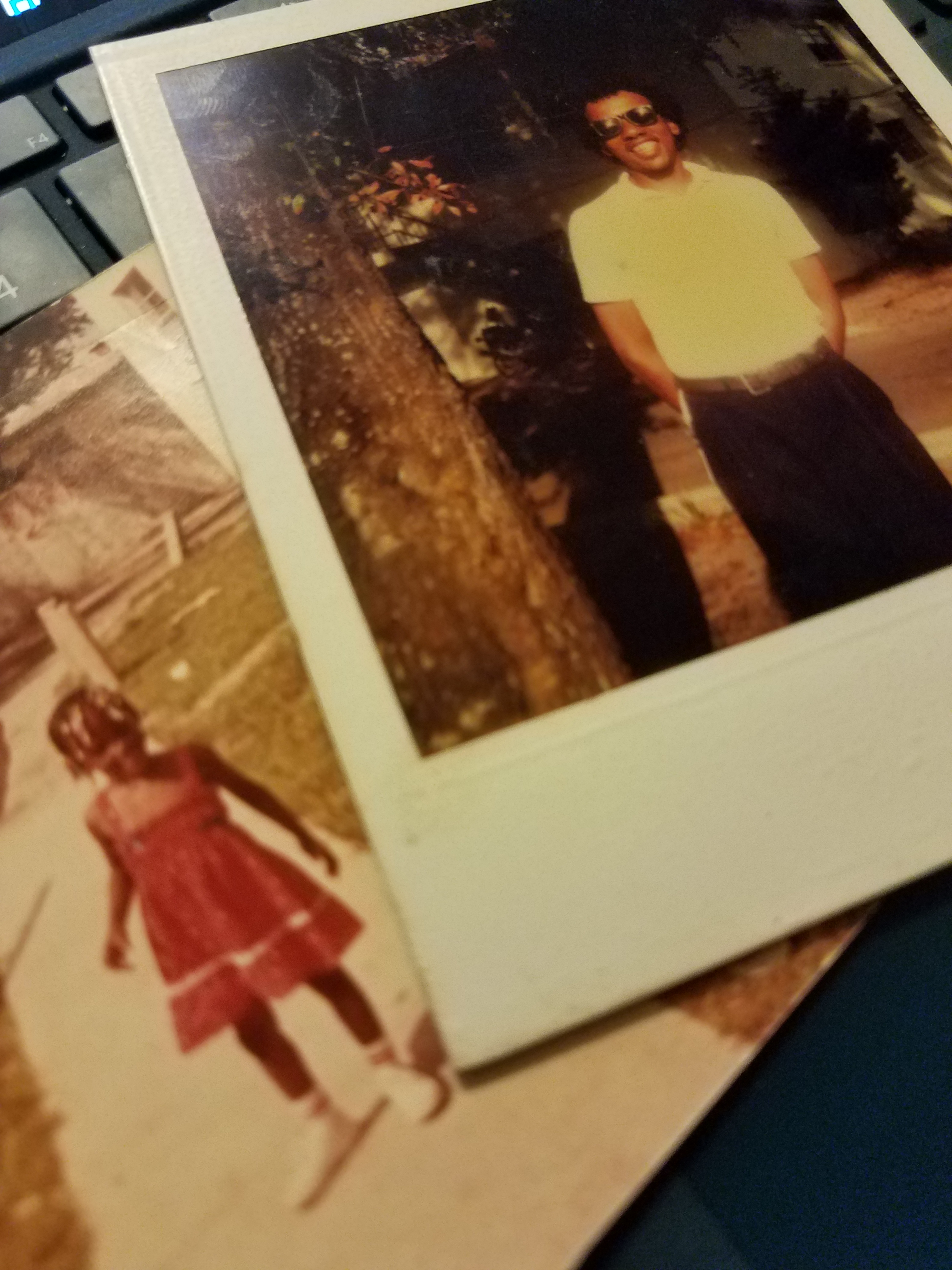
    Shout out to my father with the “BluBlockers” in the featured pic of this blog.  I love you mane.  I miss you.  Happy Father’s Day.  I’ve heard you were a proud father and I will have to believe the account of those that knew you.  – Your daughter

    “I sought the Lord, and he answered me and delivered me from all of my fears.”

    Psalms 34:4

  • The Suffering Saint

    The Suffering Saint

    Recently, I have spent a lot of time thinking about suffering and my desire to avoid it at all costs.  It sucks to suffer. End of story.  January was laden with suffering and loss for a few of my friends; 3 funerals in 3 weeks to remember the lives of 2 fathers and 1 son.  Grief and sorrow have a way of lingering.    Jesus agreed with this sentiment as reflected in Matthew 26:38, where he stated, “My soul is overwhelmed with sorrow to the point of death…”  Again, suffering sucks.  The unsettling truth is that as a follower of Jesus, I should not only come to expect the blessings of God, but with great certainty I should be mindful that suffering is also on the path of sanctification. Difficult truth.  And it sucks.

    suf·fer
    ˈsəfər/
    verb
         1. experience or be subjected to (something bad or unpleasant).
    This fixation on the avoidance of suffering came about after spending time visiting a friend in South Africa, where there is a chasm of classism left from the wreckage of apartheid.  During this visit more than any other, there was an acute awareness of the role that race has played in providing privilege to some and not to others.  As our conversations grew in depth, we both surmised that without even knowing it, we had developed an unhealthy expectation of “entitlement” to blessings as a believer and follower of Jesus Christ.
     en·ti·tled
    inˈtīdld,enˈtīdld/
    adjective
    1. believing oneself to be inherently deserving of privileges or special treatment
    It was almost as if we had said to God, suffering is for someone else, definitely not me. This unspoken paradigm of entitlement can wreak havoc on our faith when suffering arrives.  I then began to ask this friend how she maintained her faith during her most difficult moment when she suffered the loss of someone she loves.  She stated very simply and profoundly to “loosen my grip.”  Loosen my grip on the possessions I have.  Loosen my grip on the relationships that I hold dear.  Loosen my grip on my definition of what my life should be at this exact moment.  The “loosening of the grip” is an expression to hold those things and relationships dearly loved loosely in your hands, with gratitude and knowledge that all those things belong to God.  All of them.

    “Following Jesus wholeheartedly means facing the “most brutal facts of our current reality, whatever they might be” while holding on to our absolute certainty that we “prevail in the end” through his love and grace.” – Rick Lawrence, Jesus-Centered Life

    Perhaps a small part of what makes suffering bearable is our ability to savor what is good in that moment.  Another nugget of truth is that we can’t always see the things that are good in the moment of suffering.  What I learned during my time with my friend is that it is NOT in the overt acknowledgement of “all that is good” that gratitude arises.  It actually arises as we choose to be present with those who are suffering.  Present during the smiles. Present during the sorrow.  Present during the silence.

    I observed a lot of natural beauty during my time in South Africa, but there was nothing more beautiful than the comfort of a friendship that has lasted 13 years.  There was no pretense.  I liken it to the comfort of a good pair of old jeans.  They have holes, they aren’t perfect, but they fit in all the right places.

    I thought my time in South Africa would leave me only longing to ease the suffering of strangers.  That occurred.  I didn’t know that my time in South Africa would teach me in part, how to lament with the suffering saint and also teach me that suffering/sorrow/grief has no zip code.


    I want Jesus; fully and completely.  However, I still don’t want to suffer, but if I must, may I do so by leaning into Jesus and loosening my grip on all the things I’ve deemed too precious to lose.

  • Brothers Forgive Me

    Brothers Forgive Me

    This unsolicited request for forgiveness is long overdue.

    This cry for forgiveness is birthed out of a new revelation of the deep and damaging impact of mass incarceration on men of color; men of color like my brothers.  The brothers that I grew apart from long before we grew up because in their youth they experienced the dehumanization and desensitizing that happens upon incarceration.  I have been writhing with grief after watching “13TH” on Netflix.  This sense of sadness and shame that has come at the realization, that, I, your sister, have not advocated for you, my brothers.  My blood.  I’m sorry bros.  I love you bros.  I just didn’t know bros.

    This documentary on Netflix speaks of the loop hole in the 13th amendment which essentially provides a clause for criminals to continue to be subject to slavery or involuntary servitude.  The mythology of black criminology is pervasive in media and culture today, but it began long ago.  It is startling and disheartening how the narrative of slavery lives on in present policies and systems, cloaked under the guise of “criminal justice.”

    “We now have more African Americans currently under criminal supervision than all the slaves back in the 1850’s.”  – Senator Cory Booker

    This slideshow requires JavaScript.

    In the past, I shied away from watching TV series such as “Lockup” because these shows brought me incredibly close to some of the realities of those I love.  The brutality.  The identification by number not name.  The memories of visitations as a college student and beyond.  Remembering how unsettling it was to be frisked and undergo stringent visitation requirements.  Remembering the joy on your face and your warm embrace when I arrived for a visit.  Remembering the fear that came over me prior to every visit.  Fearing that I would be denied the opportunity to visit you.  Fearing that you were no longer allowed to see me.  Fearing something would always sabotage our brief connection.  And brief it always was.

    As we fast forward to the present, I am ashamed to state that I’ve had the same expectation of many who have no real context of what it means to be incarcerated and that expectation is to simply “move on after release.”  I remember the joy I had upon your release and I also felt quite lost because I didn’t know what to say or do.  At times that feeling remains.  You are an adult now.  And so am I.  You’ve experienced trauma for which I have no context, and sadly, I’ve expected you to simply bear that weight alone.  I’ve also expected you to easily navigate broken systems in our culture that express that although free, you are still not deemed a citizen.  Systems which prevent you from voting, exacerbate the cost of health care, increase barriers to employment, and multiply the cost of higher education.

    Forgive me for not acknowledging your pain.

    Forgive me for not acknowledging your victories.

    Forgive me for not using my voice and influence to not only advocate for proactive efforts that work to prevent young people from experiencing this trauma, but also advocate for young people who have been left to recover on their own after this trauma.

    Forgive me for not asking you how you were doing after release.

    Forgive me for moving on with life and expecting you to do the same.

    I am DEEPLY sorry.

    The physical chains remain in the transport of men and women into incarceration, but the mental chains are just as significant.

    On the eve of my 37th birthday, I am so grateful for lessons that my thirties continue to teach me.  The current lesson is to “keep learning.”  I am learning that my story, our family story is even more beautiful as I see the impression of your collective strength throughout it.   Your journeys have been incredibly difficult.  You guys have all continued to fight to be better men and good fathers.  Perfection is an illusion made for TV; I’ve yet to meet a perfect person.  You all could have thrown in the towel after each rejection post interview.  You didn’t.  You could have complained repeatedly.  You haven’t.  I know that your sons and daughters see you as heroes and so do I.  Thank you for displaying what it means to persevere.

    I am one who advocates for the marginalized; the outsiders, but I have been unknowingly callous to the implications of mass incarceration on our black men (brothers), our communities, our families.  I am still uncertain of how to advocate well.  I don’t know what I don’t know.  I am hoping that you all will become my new instructors.   I have so much more to learn.   So much more to learn from you.

    I love you guys.  Thank you for being gentle and patient with me in my ignorance.  It has taught me to do the same with others.

    Be completely humble and gentle; be patient, bearing with one another in love. Ephesians 4:2 [NIV]