#Wakandaforever and ever and ever. 🙅🏾 Seriously.
Short caveat before providing a minor critique of the response to the Black Panther movie. ~ Black Panther was such a substantive movie. I REALLY enjoyed it and have begun to think about how I can live in such a way that Wakanda can move beyond a figment of my imagination. I’m re-imagining how I can participate in creating a world where black and brown people of the diaspora know their worth, are proud of their ethnicity, freely celebrate their culture, and have the skills necessary to drive innovation in technology.
Caveat over. 🙅🏿
Men, I need to talk to y’all. Especially black men. I need answers. Stat! Maybe you’ll shine some light so that I can cast less shade, because I have plenty to throw right now.
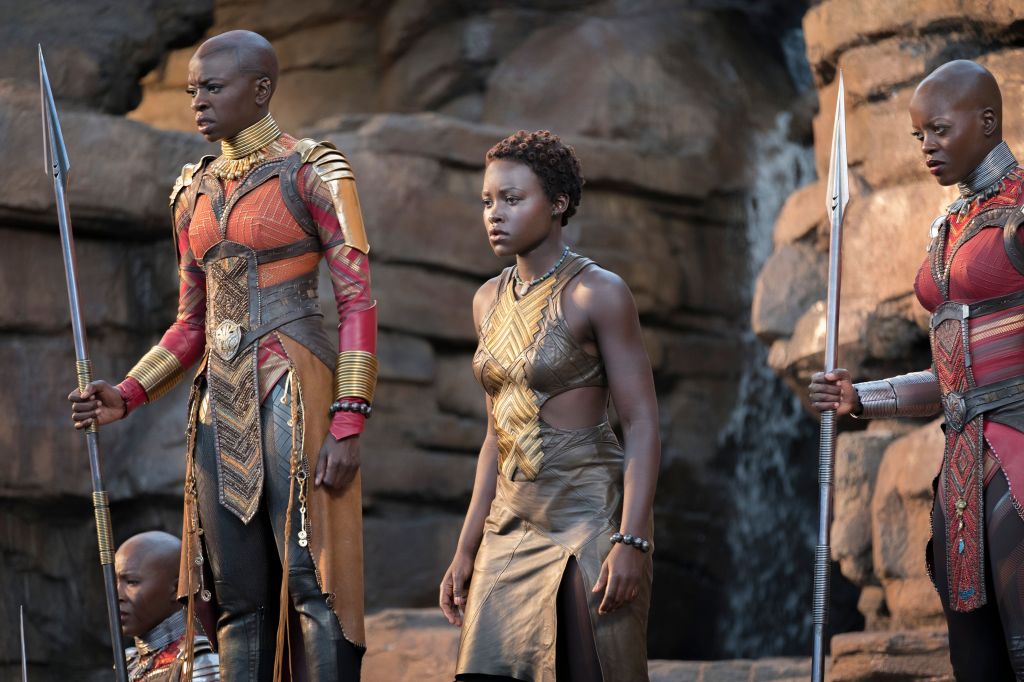
Never have I seen black women who are bald or have short hair and darker skin praised for their beauty AND strength by…black men. Black men have praised plenty of black women that have long, straight (or minimally kinky) hair, with lighter skin as beautiful. This type of praise is unconventional in the American black culture. However, since Black Panther so brilliantly displayed women with such phenotypical features, they pretty much have gained goddess status. Bruhs are like… “Nakia, Okoye, and Shuri, are my new standard for beauty…” As a woman of dark skin who’s not always experienced this type of affirmation from black men, I appreciate that! My contention is with the “new-found way in which you’ve presumably embraced my strength as well.

STRONG BLACK WOMAN – not new, so let’s not treat it as such
While Wakanda itself is a fictional place in Africa, the Dora Milaje Warriors of Wakanda are not. Arica L. Coleman, of Time, recently wrote an article, “There’s a True Story Behind Black Panther’s Strong Women. Here’s Why that Matters” that provides historical context. Many black women are unofficially given the title of “strong black woman” and it carries with it unbelievable weight, often to the detriment of emotional, physical, and spiritual health. Peep this book from Dr. Chanequa Walker-Barnes, Too Heavy a Yoke: Black Women and the Burden of Strength, if you desire some freedom here. This is not the strength that beams from my sistahs on the screen of Black Panther. It is not the strength that simply ignores pain. Not the strength that forsakes self-care for the care of everyone else in their tribe. These women are physically and intellectually strong. They are beautifully portrayed as women whose strengths are not seen as a threat, but as an additional weapon in the protection of a nation they all love. Think asset not liability.
Here’s why I’m salty. I’m salty because my social media news feed has been full of posts and comments from black men that are practically giddy with the portrayal of women in this movie. Especially commenting on their strength and beauty. Well, guys, there seems to be a contradiction in what your social media post say and what I’ve experienced in life as a real-life Dora Milaje woman. Yep, self proclaimed Milaje woman. Here’s what’s been communicated directly and indirectly to me by men as a strong black woman:
Your strength is intimidating, so tone it down and don’t have too many thoughts on the issue.
Be anything but assertive in the presence of men. Too much sauce is too much sauce. Minimize your intelligence at those times.
You are so much more beautiful if you have hair extensions that make your hair straight or very long.
Regardless of your education and experience, your voice is always less valuable than any man in the room.
Your dark skin is exotic. You are not beautiful enough to be pursued in relationship, only observed.
The list could continue, but the point is not to be exhaustive, but to challenge this notion that black men really do find the Dora Milaje warriors, Nakia, Queen Ramonda, and Okoye attractive with all of their strengths. As a friend and I discussed the movie, she brought out the perspective that because T’Challa’s black panther suit was brilliantly designed to absorb kinetic energy with each bullet fired at him and later reused in his own defense, she often wanted him to take “more hits” so that his defense would be even stronger. Such an interesting concept with parallels to black men across the diaspora. Black men have been taking hits for a long time. They’ve had a shield that absorbed a lot of the blows for them; the black woman. Black women are still absorbing daily blows for black men.
As we close out another Black History Month and a month that celebrates love, I ask men again, Wakanda woman do you really want? Many of you already have women with the strength of the Dora Milaje warriors as family members, colleagues, and friends. Hug these women. Protect these women. Walk through healing with these women. Help facilitate the dreams and gifts within these women. Love those women. #InWakanda, strength is only a threat to the enemy, not family. We are all family in the African diaspora.
After Wakanda, it appears I no longer must choose between beauty and strength. As a dark-skinned woman with thick kinky hair, it’s always been one or the other. Men, I hope my real-life experience begins to match what’s on your social media feed. I hope to see board room dynamics change. I hope to see many of my beautiful and educated, black friends change their status from “single” to “in a relationship” this year. I hope they will no longer be despised for their strength, but fully loved amid it. Brothers, if there was ever a time to shoot your shot, it’s now. Maybe elements of Wakanda will become a reality sooner rather than later…
“Gender roles and strength don’t counter each other at all.” –
Thought on Black Panther from Michelle Higgins of Truth’s Table

 “Am I Black?” This question has echoed in my mind since it was so loudly projected from the mouth of a little boy (approximately 5 years old) to his parents as he sat with them and watched a portion of a video about the middle passage at The
  Precious Predilections