Money can’t buy you love, but it can buy you justice. This position is not one for arguing – today’s contention is how to ignite hope in a community that has seen it’s dream of equality shot down decade after decade. Not false hope. Not pipe dreams. So far, this is the type of hope that generations of Black Americans have been given; false premises of being seen, heard, and valued. Unfortunately this view also permeates classrooms. Dreams devoid of hope vanish into thin air leaving it more difficult to breathe for all of us. Gasping for a hope that seems to evade.
I was unprepared for the reckoning my heart would face when I watched the movie Just Mercy. I read the book a few years ago and was wrecked by Bryan Stevenson’s compelling proposition to be proximate to the poor if you want to see change (in yourself and larger systems). I made moves. Became proximate. But let me tell you, when this book was brought to life on the screen, I could only see two things; black men in my family and the black boys in my classroom. I was unable to shake the reality of how so many of their dreams vanish into thin air early. Historically, the criminal justice system presumes guilt before trial and the classroom deems incompetent before demonstrating capability. As I wept in that theater over and over again at real lives who were deemed to have zero meaning, I asked myself about the power of hope to fuel justice.
Hopelessness is the end of justice. – Bryan Stevenson
This movie reminded me of the power of knowing you have someone in your corner fighting for you. The power of knowing that someone believes your life has value. The power of knowing that you aren’t the only one who hasn’t given up hope. The power of knowing what it feels like to receive mercy. The power of proximity to drive empathy-fueled action.
I have chosen the classroom as a place to restore hope. It is the most difficult thing I have done. It is complex and nuanced. No parent or child is the worst thing they have ever done. Each child I behold not only bears the image of God but also the hopes of their parents; their people. I get that. I know what it is to have the dreams of your family resting on your shoulders. When my students are older, I hope they know how much I fought for them. I hope they know how much I loved them. I hope they know how much I valued them.
There are lots of lessons to learn throughout the course of a school year, but I hope to infuse students and the families I serve with new hope. A new hope which restores truth to a generation of black and brown children who have been told that they are incapable. All children are capable of learning. All children are worthy of love. This blog is more of a note-to-self. May I always stand in these truths in the classroom.
“I got my truth back…you gave that to me. Ain’t nobody gone take that from us.” – Walter McMillian [Just Mercy]
Imagine what it’s like to be stuck in a reality that dismantles your family, presumes your guilt based on your God-given gear ( I’m talkin’ skin color), and leaves you with a thousand sleepless nights and I will tell you what it’s like to have a Black son, brother, husband, father or friend to undergo the unwieldy American unjust justice system. Key word here is REALITY. For some the account of When They See Us by Ava DuVernay is philosophical and conversations loom around poetic pros and pithy arguments, yet I am unable to escape the striking resemblance to my family’s reality of justice gone wrong.
So many images from this series are seared into my psyche but none more piercing than that of a pride so deep that produces prejudicial action. This is the stuff of oppressive systems. My stomach turned in knots as I realized that when they (Whites) see us, they remember her (White investment banker brutally raped). How could they not? A judge, who like most, keeps a doting picture of his (White) wife on the bench; a young, White female prosecutor; fill in the _____________. A quick substitution of the rape victim with the face of the one they love and the five black boys on trial are no longer seen as such, but as a wolf pack to protect their loved ones from. This instinctive ability to re-imagine ourselves or a person we love/care about that has been victimized is all natural. Development of my empathetic muscles has come from a place of love through proximity. So, I’ll say it – love differently ya’ll. Love different people from different places of different races with different experiences and I am certain you will no longer see a wolf pack. You’ll see a student, a friend, someone’s brother, a child, a person.
On the other side of incarceration there are parents, siblings, children, friends who experience loss from a system designed to keep so many bound.
When They See Us not only exposes what happens when justice moves away from righting wrongs to jockeying for power, but also depicts the complex choices of those “on the other side.” It highlights how the pressures of our penal system forces parents to choose between provision and purported protection. Complicated.
Antron’s dad lost his son trying to protect him. Raymond’s dad would forever regret sending him to the same park where he would be targeted by police. Kevin’s sister is crushed by her 14 year old brother’s tear-filled plea to simply return home and signs a coerced confession. Complicated. Somehow through deep loss and grief, those on the other side are able to beautifully uphold the dignity of those they love. While it is painfully obvious during each episode that whiteness affords many the privilege of a better trial than their Black counterparts, I found a few other lessons embedded within.
Clinging to normalcy: the return home. The return home is anti-climactic. Fathers unprepared to receive the sons they’ve betrayed by choosing absence on court dates. Sons bravely clinging to normalcy found in the days of old. Holding tightly to the culmination of belongings in a brown paper bag. Dreaming nightly of the return home only to realize that the heart’s deep love must now sync with the awkward moments of freely being present with loved ones as the muscle memory of trauma reminds everyone to restrain affection and the expression of feelings. Trauma makes normal abnormal. We must be gentle with one another.
We are not okay: lying to survive The penal system can produce a family of pretenders. We all pretend that everything is okay post incarceration. Because how do you even begin to process that all involved have less hope in a justice system that doesn’t value our Black lives or legacy? Korey’s mom would ask him, “What is it like for you in here? Are they treating you okay?” His response was always, “I’m surviving…” or “I’m holding it down…” Responses which are echoed all across America. We may never know the entire story of someone’s trauma. For those that choose vulnerability, let them do so in their own time and in their own way. We must be gentle with one another.
“I’m just a shadow,” says Korey Wise, one of the exonerated five and victim of horrific beatings. “I’m very empty — 46 years old and empty. At the same time, I’m talking to the kid in me: ‘I got you, baby boy. Nobody can take your story from you.’”
Real love…I’m searching for a real love…someone to really see me. (cue Mary J. Blige song) It is real love that slowly shifts our gaze beyond bias and towards humanity. Love is less about whimsy, more about choice. It is an outright intention to choose another over yourself. It is sacrificial at it’s core. Consider those on the other side of incarceration (or providing trauma support) and ask yourself, how have I loved them? These parents, children, siblings, loved ones are often left in the shadows. Those who’ve directly experienced trauma and those supporting them need that real love.
“All I do all day long is LOVE YOU.” — Mother of Antron McCray, one of the exonerated five boys.
Short caveat before providing a minor critique of the response to the Black Panther movie. ~ Black Panther was such a substantive movie. I REALLY enjoyed it and have begun to think about how I can live in such a way that Wakanda can move beyond a figment of my imagination. I’m re-imagining how I can participate in creating a world where black and brown people of the diaspora know their worth, are proud of their ethnicity, freely celebrate their culture, and have the skills necessary to drive innovation in technology.
Caveat over. 🙅🏿
Men, I need to talk to y’all. Especially black men. I need answers. Stat! Maybe you’ll shine some light so that I can cast less shade, because I have plenty to throw right now.
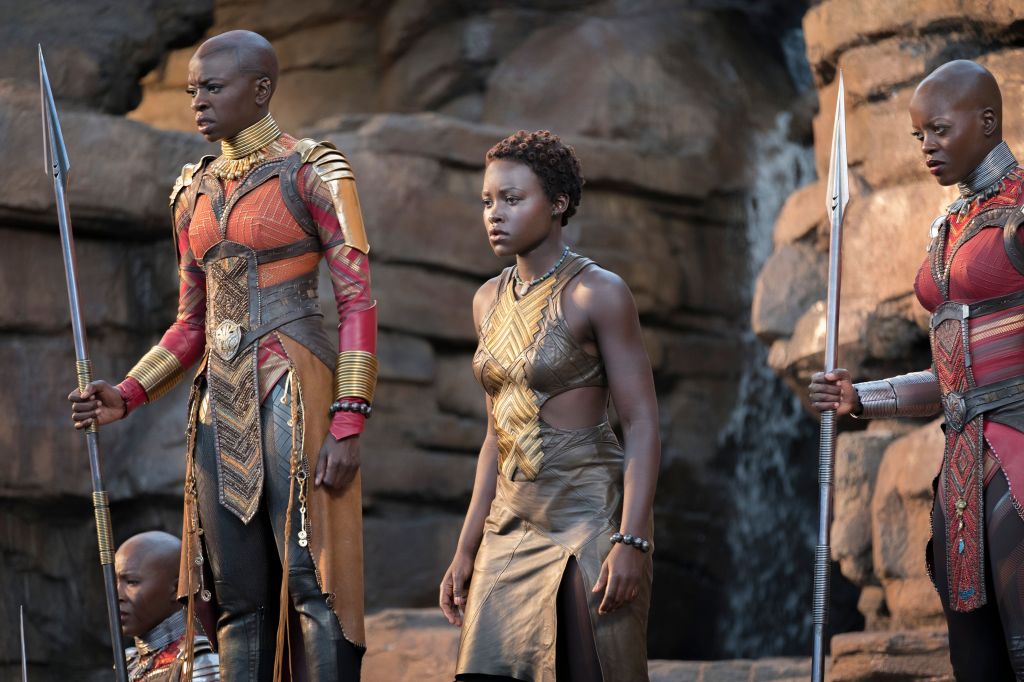
Never have I seen black women who are bald or have short hair and darker skin praised for their beauty AND strength by…black men. Black men have praised plenty of black women that have long, straight (or minimally kinky) hair, with lighter skin as beautiful. This type of praise is unconventional in the American black culture. However, since Black Panther so brilliantly displayed women with such phenotypical features, they pretty much have gained goddess status. Bruhs are like… “Nakia, Okoye, and Shuri, are my new standard for beauty…” As a woman of dark skin who’s not always experienced this type of affirmation from black men, I appreciate that! My contention is with the “new-found way in which you’ve presumably embraced my strength as well.
Letitia Wright, Lupita Nyong’o, Angela Bassett and Dania Gurira photographed exclusively for Entertainment Weekly by Koury Angelo is Los Angeles on January 30th 2018 photographed exclusively for Entertainment Weekly by Koury Angelo is Los Angeles on January 30th 2018
STRONG BLACK WOMAN – not new, so let’s not treat it as such
While Wakanda itself is a fictional place in Africa, the Dora Milaje Warriors of Wakanda are not. Arica L. Coleman, of Time, recently wrote an article, “There’s a True Story Behind Black Panther’s Strong Women. Here’s Why that Matters” that provides historical context. Many black women are unofficially given the title of “strong black woman” and it carries with it unbelievable weight, often to the detriment of emotional, physical, and spiritual health. Peep this book from Dr. Chanequa Walker-Barnes, Too Heavy a Yoke: Black Women and the Burden of Strength, if you desire some freedom here. This is not the strength that beams from my sistahs on the screen of Black Panther. It is not the strength that simply ignores pain. Not the strength that forsakes self-care for the care of everyone else in their tribe. These women are physically and intellectually strong. They are beautifully portrayed as women whose strengths are not seen as a threat, but as an additional weapon in the protection of a nation they all love. Think asset not liability.
Here’s why I’m salty. I’m salty because my social media news feed has been full of posts and comments from black men that are practically giddy with the portrayal of women in this movie. Especially commenting on their strength and beauty. Well, guys, there seems to be a contradiction in what your social media post say and what I’ve experienced in life as a real-life Dora Milaje woman. Yep, self proclaimed Milaje woman. Here’s what’s been communicated directly and indirectly to me by men as a strong black woman:
Your strength is intimidating, so tone it down and don’t have too many thoughts on the issue.
Be anything but assertive in the presence of men. Too much sauce is too much sauce. Minimize your intelligence at those times.
You are so much more beautiful if you have hair extensions that make your hair straight or very long.
Regardless of your education and experience, your voice is always less valuable than any man in the room.
Your dark skin is exotic. You are not beautiful enough to be pursued in relationship, only observed.
The list could continue, but the point is not to be exhaustive, but to challenge this notion that black men really do find the Dora Milaje warriors, Nakia, Queen Ramonda, and Okoye attractive with all of their strengths. As a friend and I discussed the movie, she brought out the perspective that because T’Challa’s black panther suit was brilliantly designed to absorb kinetic energy with each bullet fired at him and later reused in his own defense, she often wanted him to take “more hits” so that his defense would be even stronger. Such an interesting concept with parallels to black men across the diaspora. Black men have been taking hits for a long time. They’ve had a shield that absorbed a lot of the blows for them; the black woman. Black women are still absorbing daily blows for black men.
As we close out another Black History Month and a month that celebrates love, I ask men again, Wakanda woman do you really want? Many of you already have women with the strength of the Dora Milaje warriors as family members, colleagues, and friends. Hug these women. Protect these women. Walk through healing with these women. Help facilitate the dreams and gifts within these women. Love those women. #InWakanda, strength is only a threat to the enemy, not family. We are all family in the African diaspora.
After Wakanda, it appears I no longer must choose between beauty and strength. As a dark-skinned woman with thick kinky hair, it’s always been one or the other. Men, I hope my real-life experience begins to match what’s on your social media feed. I hope to see board room dynamics change. I hope to see many of my beautiful and educated, black friends change their status from “single” to “in a relationship” this year. I hope they will no longer be despised for their strength, but fully loved amid it. Brothers, if there was ever a time to shoot your shot, it’s now. Maybe elements of Wakanda will become a reality sooner rather than later…
“Gender roles and strength don’t counter each other at all.” –
Thought on Black Panther from Michelle Higgins of Truth’s Table



 Precious Predilections